As a former scout and medic and a current fire captain, I love getting outdoors and hiking. I’ve had so many personal backpacking and camping adventures. Now, I’m happy to share my passion with my family. We try to get out at least once a week for family hikes. Lately, we’ve noticed an increase in those we see hiking, both on the trails alongside us and sharing their pics on social media.
If you’re new to hiking or just looking for some reassurance that you are prepared for anything on the trail, we’re here for you! We’re sharing tips for planning and packing for family hikes and what to do if something goes wrong. We hope you learn something new here. Remember, everyone has to start somewhere!
5 Things to Consider When Planning Family Hikes
Pick a trail that is age appropriate for your kids.
Younger kids may like trails that are more scenic and flat. If your kids are older, they may be up for the challenge of going on more adventurous family hikes. If you have young children and older ones, you can use a backpack style kid carrier for your younger kiddos and still hit those more challenging trails.
But where do I find these trails? Fear not!
There are countless resources on the internet if you just search “best hiking trails for kids (insert location here).” I use an app called AllTrails. It gives ratings provided by other users based on difficulty level, scenery, and any other notable particulars.
Pack a first aid kit.
Your first aid kit for the average family hikes doesn’t have to be an all out apocalyptic survival bag. It just needs the basics, like bandages of different sizes, antiseptic wipes, anti-itch cream, and antibiotic wipes.
If you’re going on longer hikes, consider adding a whistle and signaling mirror to call for help if needed, iodine tablets for water, and moleskin for blisters. You can shop our take-along first aid kits right here.
Bring plenty of water and snacks.
This one is really important. There are different varieties of water carrying options. You can use a water bottle, water bladder, or even a water backpack. The key is to continually hydrate throughout your hike rather than chugging it when you take a rest or make it to the summit.
Ideally, you should be drinking small sips every 15-20 minutes. You may want to drink more often in higher elevations and when the weather is colder. It’s a good idea to bring some electrolyte packets or sports drinks, too, but be mindful of the sugar content of some of those sports drinks.
Don’t forget your maps and/or GPS.
Most mobile phones have GPS and mapping apps that will keep track of your location while you’re out and about. Like I mentioned above, we prefer to use an app called AllTrails, but there are some other great ones, too. If you’re in a remote area with no cell service, you can still use GPS or a good ‘ole-fashion paper map and compass. Knowing your exact location will help you summon emergency services if needed.
You’ll need sunscreen and bug protection.
Sunscreen is important even if you feel like you’re being shaded. It’s especially important on open trails with no natural sun protection. Make sure you’re using the appropriate sunscreen for your skin type.
When it comes to bug protection, we prefer to use products with a picaridin or DEET. Those products seem to be more effective. There are even some outdoor clothing manufactures who impregnate the fabric with picaridin!
Dress appropriately and be prepared for any changes in weather.
Before you head out, make sure you take a look at the weather forecast. There are many times you may start out on a hot sunny day and then it starts raining on you. This occurs quite frequently in higher elevations.
Good sturdy shoes are a must. If you’re just heading out for an easy day hike on a flat trail any closed toe shoe will do (this goes for the kiddos too if they’re walking). Who knows when you or your kids will unintentionally kick a rock…OUCH!
If you’re going for a longer or more challenging hike, good shoes are a must. Speaking of musts, good socks prevent blisters. I use wool socks or a synthetic derivative such as Smartwool.
4 Things to Have on Hand.
Snacks for the kids. Make sure it’s something they really like!
Binoculars to look at nature without getting too close.
A notebook with crayons or colored pencils. This is a great activity for kids who like to draw and journal their findings on their hiking adventure. Many state and national parks have junior ranger programs. They have activity books and scavenger hunts so that your kids can earn their junior ranger badge.
A good size, comfortable backpack. For me, I do not skimp on the backpack. Since I’m usually the one carrying everything, I want to be comfortable. There are also hydration backpacks and options to add a water bladder to your existing pack.
3 Common Hiking Injuries and How to Treat Them.
Scrapes or abrasions:
The most common are scraped knees and elbows when you or your child trip on the trail. The best thing to do is use water to rinse out any dirt or debris in the wound, place an antibacterial ointment on, and an appropriately sized bandage. The key is to thoroughly clean and scrub out the wound with soap and water when you get back home.
Deeper cuts:
You certainly can receive deeper cuts when on family hikes. It can be from a fall or from scraping a sharp rock or a branch. The best thing is to keep them clean until you can get more advanced care.
If you receive a deeper cut that requires stitches, first rinse it out with clean water and remove any larger debris. Apply antibiotic ointments to the area and cover it with clean bandages or dressing. You can use skin glue with a combination of steri-strips (wound closure strips) to seal up the wound if you’re not close and able to quickly receive advanced medical help.
Bug and animal bites:
Generally most small bug bites are not serious unless you have an allergy to them. For most, it’ll just be redness to the area, minor swelling, and itchiness. Those can be treated with some ice packs and anti-itch cream to the area. You can consider some antihistamines as well.
If the person that you’re treating starts developing more serious signs and symptoms of an allergy like decreased or altered mental status, difficulty breathing, tongue swelling, or hives all over the body, they need immediate medical assistance. Call 911 or find a way to get help immediately.
There are animals and bugs that are dangerous to humans and they vary from region-to-region. You need to be aware and research what they look like before heading out. That way you can avoid them or know what to do if you get bit by one.
Hopefully you’ve found this guide to family hikes easy to use and super informative! If you’re looking for more info on common kid emergencies, check out our FREE handbook for moms! And don’t forget to grab a PreparaKit if you don’t already have one.
Being prepared in our finances can empower us because it impacts all of the areas of our life. Knowing this simple fact led me to put together a five phase journey based on my own experience with finances and the experiences of those I’ve helped along the way. My hope is that this framework will show you the path to financial freedom.
Knowing where you are at and which direction you’re heading in is vital to moving towards where you ultimately want your end destination to be. These are the five phases we went through. If you can identify which of the behavioral phases you are in, you’ll also be able to identify the steps you need to take to move forward on your journey.
Wondering which phase you are in? Check out my 5 behavioral phases of the finance journey!
Phase 1 – Denial
This is where most people begin their financial journey. When my husband and I were first married, we were definitely in denial about our finances. We thought we had all of the money in the world and we were spending on credit like there was no tomorrow. We racked up debt on over 11 credit cards. Since we could afford the minimum payments on them, we thought we were fine. You know the motto, “Buy now, pay later”? That was us. Trust me, we sure did pay later!
We were in denial that we couldn’t really afford these things. We were in denial that we had a spending problem.
Phase 2 – Avoidance
In this phase, you start to recognize that you have a spending problem, but you’re doing things to avoid the issue because you don’t want to deal with it. But, at the end of every month, you need to come up with money to pay the bills and you’re noticing that your credit cards are maxed out.
For us, we had our 11 credit cards, and we found ourselves signing up for new credit cards each month with 0% interest rates. Then, we would transfer our balance from one credit card with a high interest rate to this new low interest card. Essentially, we were just moving our problems around – not solving them.
This process took care of some of the fees, but it didn’t solve the actual problem – which was our spending. We knew there was a problem, but we were avoiding it. We didn’t want to address it.
Phase 3 – Frustration
Eventually, if you are stuck in the denial or avoidance phases for long enough, you will start to get frustrated with your lifestyle. Living paycheck-to-paycheck, being tired every month of not knowing where all of your money is going, and having those arguments every month with your spouse or partner about money are just so frustrating.
That level of frustration at not knowing where your money is going, being disorganized with your finances, and over spending will start to build up and catch up to you. For myself and my husband we were in the avoidance and frustration phases for a long time. We finally decided enough was enough and we didn’t want to be stressed out and frustrated anymore. This led us into the next phase.
Phase 4 – Exploring
Once you’ve decided that you’ve had enough of the stress and frustration, you’ll begin to explore your options. We knew we needed to do something so we started to look at our situation and considered getting outside help. We took a good hard look at our lives and began to think about what it is that we wanted for our future.
Whether or not you do this yourself with all of the resources out there, you ask family and friends for tips and suggestions, or you get professional help, it’s important to find a solution to the problem you are having and begin to work on the issues. And this slowly moves you towards the final phase – the place where we all want to be!
Phase 5 – Control
The final stage brings us confidence and control. This is where we all hope to end up with peace of mind and stress free living. This is what we all want for our lives and our families.
Ask yourself – which phase are you in now? This might sound crazy, but if you are in the frustration phase, this is a great place to be! Here’s why: If you are frustrated, you’re likely ready to take action and make a change.
Now that you’ve identified which of the behavioral phases you’re at, it’s time to make a plan to move you along on your journey. Lucky for you, I can help with that! Let’s set a time for us to chat about how we can get you in control of your finances!
Did you know it’s super easy to teach your kids about different money lessons?
Most people grow up not learning money lessons from their parents. They have to go through life and learn it the hard way, like I did. I learned from my parents to just – work, work, work, save and not spend. That can be a money lesson but I’m here to encourage you to teach your kids to manage their money more effectively.
There are so many easy opportunities in everyday life where we can teach our kids about money. These teachable moments are scattered all throughout your days and I want to share a few of them with you so the next time you do it, you’ll recognize it and say to yourself, “Oh, this is a teachable moment!”
Finance is a huge part of our lives. If kids don’t learn about it early on, it will create huge issues for them in adult life.
Why even talk to our kids about money when they are young?
You might be thinking – why bother, they’re so little? They’re just kids. Starting at 5 or 6, it’s okay to start. And you’re likely already doing it in small ways. As they get older, we want them to develop better habits and have a healthy relationship with money.
If we don’t share with them about money, they will grow up thinking money grows on trees. Or, they’ll go away to college and keep calling asking for money. We don’t want that. We want them to be self-sufficient. We want them to go to college and be able to manage their money on their own – plus understand and value money and have a healthy relationship with it.
When they learn these lessons early on, they will grow up and appreciate money but also – money won’t control their lives. They will control their money – instead of the other way around.
I want to teach my kids skills so they can value and understand money. Now, you might be thinking, “I’m not good with money, how can I teach my kids about money”. Well, you can use these tips to start implementing positive money habits in your own life, too.
Here are 3 easy ways to talk to your kids about money lessons in your day-to-day life:
Have Your Kids Track Your Eating Out Budget
You might not have any idea how much you spend to eat out each month. That’s okay, you can start now with the help of your kids!
We set a dedicated amount each month for this. For us, it’s usually around $400. If we had some left over from the previous month we roll it over into the next month. I have my kids track this budget using a calendar board in our living room. Each time we eat out, I have them write down where we ate and how much it cost. Then they subtract it from the budget.
My kids are a bit older, 10 and 12, so they can do the math themselves. If you have younger kids, you can work through the math together with them and explain to them what you’re doing and keep yourself accountable as well as start to expose them to what you’re doing.
The goal is that by mid-month, you’re only about halfway through your budget. So, when my kids come to me and ask if we can go out and get some Boba drink, I ask them to look at the board and see how much we have left in our budget.
Here’s the teachable moment – I tell them, if we spend it all now, that means we have 2 weeks with no money to spend on treats and eating out. So I try to teach them to spread it out evenly. Go at a balanced pace, don’t spend it all up front. If we are out of money and they ask to go out for food – we say there’s no more money for that. My kids are okay with that now because they understand. It helps to keep all of use accountable for not overspending on eating out.
Talk to Your Kids and Get Them Involved in Tracking Common Bills
We use the same board in our living room to track our common household bills like water, electric, and cable/internet – stuff that the kids use regularly.
Every month, I write down how much we spent that month on those bills. If the water bill happens to be a little higher one month, I’ll point it out to the kids and get them thinking about why that is. I’ll recommend to them to be more mindful of how we’re using our water and electricity in our day-to-day life. I also point out if the bills are going down and I say, “Wow you’re doing really good, guys!”
You’re already paying bills each month, so I recommend just pointing out what you’re doing to the kids so they’re aware, too.
Teach Your kids the Difference Between Needs and Wants
When you’re at the store or talking with your spouse about getting something new, you’re already running through it in your head. Just talk it out with your kids. Talk about if it’s something you truly need or something you just want. Ask, “Do we really need it?” Let your kids hear you talking about it and expose them to the conversation. Get them used to the habit of taking a step back before making an impulse buy.
Our kids have gotten used to this. When we go to the store, they know that we won’t make impulse buys.
There are teachable moments all day, every day with our kids. When you are already doing something, talk to your kids and involve them in it. The worst thing you can do for your kids is to keep them out of the loop when it comes to money lessons. Not teaching your kids about money management could lead to kids accumulating tons of debt and I know I don’t want that for my kids. If there is something I can do to help prevent my kids from getting sucked into the trap of money issues, I want to do that.
If you’d like to learn more about budgeting, I’ll be hosting a Happy Family Budgeting Workshop. Head here for all of the details and to get signed up!
Are you currently paying your kids to take care of certain jobs around the house? Or do you give your children a weekly allowance without requiring them to do anything to earn that money?
A while back I had an idea. I was always buying things for my kids and I thought, why don’t I take that money I was going to spend on them anyway and actually teach them some money lessons instead. Why don’t I pay my kids to do jobs! I love a good teachable moment!
Of course, my kids have chores that need to be done regularly around the house. Think: making their beds and doing their laundry. I’m not talking about those things. I’m talking about the things that go above and beyond the normal daily household routine, like things that could be taken off my plate. For example: vacuuming the stairs, cleaning the microwave, or dusting the baseboards and shutters. Now, I pay my kids for doing those things.
If you’re wondering why, here are the 3 main reasons I pay my kids for doing these jobs around our house:
I want to teach them the basics of money management.
These are things like saving, spending, and giving. These are basic money lessons they are going to need to learn eventually. Why not start earlier on?
So, I’ll ask them what it is that they want to buy and they can slowly work up to saving for that thing. I have them divide the money into those 3 categories. How much do they want to put toward their goal, how much do they want to have available to spend on a treat, and how much do they want to put towards charity or gifts for others.
Now, this concept of teaching them to save what they’ve earned is really helpful in letting them in on how to budget their pay in the future. It starts them out on those habits but on a smaller scale. It will lead to a healthy relationship with money once they start earning their own income.
What I’ve noticed is that when they are using their own money, they are a bit more conservative with their spending. This tells me that what I’m teaching is really sinking in!
I want them to learn to have a solid work ethic.
They know this is a job and they know they have to do it well. Just like when they get out into the real world, they need to do their job properly in order to get paid. If they rush through it or don’t do a good job, I have them do it over before paying them. This teaches them the kind of work ethic I want them to have. Life isn’t just about having fun, you need to work hard, too. I always tell my kids: work hard, play harder.
In our house, the kids do their jobs on Saturday. They have to get their jobs done before they even think about opening their iPad or turning the TV on.
It’s all about responsibility.
My kids are each assigned different jobs and they are each responsible for making sure their job gets done and that it gets done well. If they are assigned a job, they need to do it and take ownership of their responsibilities.
Allowances vs. Jobs
If you are one who gives an allowance to your kids, I highly recommend you switch things up a bit. At the very least, in the verbiage. Think about what the word “allowance” says to your kids as compared to calling it a job and paying them for doing that job. When kids get an allowance, sometimes they feel entitled to the money instead of having to work for it. As adults, we know this isn’t how the real world works. We need to work in order to earn money, we aren’t just given money for existing. (though that would be nice, right?) It’s a tiny shift in language that could make a huge shift in your kids mindset and attitude.
If you’d like to learn more about budgeting, I’ll be hosting a Happy Family Budgeting Workshop in just a few weeks. Head here for all of the details and to get signed up!
Recently, I interviewed a real life Fire Captain about all things fire prevention and what to do if a fire does break out. We broke the interview down into a few blog posts so that you can easily find the information you are looking for. In the first blog post, we covered preventative items to have in your home. This time, we’re talking about real life fire scenarios he’s seen and what you and your family can do if you find yourselves in one of these situations.
For families, knowing what to do in the instance of an emergency is extremely important. In our house, my Fire Captain husband is often away overnight and for long shifts. That makes it even more important that my kids and I are prepared for anything that comes our way.
Here are 6 real life fire scenarios and what you can do if you find yourself in these situations:
Not knowing how to shut off utilities.
This would be water, electricity, and gas. Recently, a dad was replacing a water faucet at his house and he hadn’t shut off his water. He ended up flooding his entire second floor and the fire department had to respond to help him shut it off.
It’s good to know how to shut off your gas, especially on the west coast, incase of an earthquake You also want to know how to shut off your electricity at the breaker panels in case of an emergency.
You can find resources online with your utility providers to help you in locating the shut offs for each utility.
Starting an oven fire.
Oven fires can happen when you leave something in the oven for too long or when grease makes its way down to the heating element. I did this once when I was making tacos!
If you have an oven fire, you can close the oven door, which will cut off the oxygen supply to the fire or sprinkle some water into the oven. The water will expand into steam and steam will put out the fire.
If it is beyond that, just close the oven door and call 911.
Putting Metal in the Microwave.
Some people might think this is common knowledge, but based on the number of calls my husband has been on for this, I now know it’s not! This means don’t put utensils, tin foil, or any metal containers in the microwave. It’s also important to make sure your kids and teenagers know this one, too!
Your microwave manual should say not to microwave anything that could be magnetic. The microwave will react with the metal and cause it to overheat and possibly blow out your microwave.
Overloading your power outlets.
This is a big one! Many people use power strips and extension cords with multiple outlets to plug in things like heaters. They will even plug a power strip into another power strip, and then into another like a daisy chain. Sometimes, 6 cords running off of each other. This can cause a huge fire in the wall because it overloaded the circuit and melted the cords.
Things like electrical heaters use a lot of power and create a lot of heat. The cords get hot and can melt. If they are touching any furniture or cloth, this can cause a fire.
Don’t daisy chain or overload power strips or outlets. Plug directly into the wall or get an extension cord that is the proper length.
Leaving a bathroom fan on all day.
Bathrooms fans are not designed to run more than a few hours at a time. When you run a bathroom fan for more than a few hours, it can cause the motor to overheat and start a fire. Oftentimes, based on the placement of the bathroom fan, this will lead to a dangerous attic fire.
You can install a timer on your bathroom fan so that it will turn off after a set amount of time, preventing the motor from overheating and causing a fire.
Dropping a turkey into a deep fryer.
Lots of people love to deep fry their turkeys around the holidays but it might be more dangerous than you think! If you drop a turkey into a deep fryer too quickly it will cause a huge raging inferno ball that can harm those nearby and spread to other areas. The inferno ball can spread to an awning, fabric umbrella, or even the house.
But what do you do if you find yourself in one of these situations?
You can always be prepared ahead of time by having a plan! Practice your exit plan at home with fire drills. Hey, why not, the kids do them at school, do them at home, too. This will help to eliminate panic.
You don’t want your child to be scared and hide. You can go to your local fire station and introduce your child to fire fighters. Ask them to put on all of their gear so your child will know what they look like and sound like in full gear so they will feel comfortable and less anxious if they do see a firefighter in a dangerous situation.
If there is a fire in the home, get out as quickly as possible and call 911. If you are trapped, put towels under the doors to keep the smoke out and stay low.
Bonus Tip: Sleep with your bedroom door closed!
This might not seem like a big deal, but we’ve seen situations where an entire apartment was destroyed with the exception of the bedroom that had the door shut. If you don’t believe me, go check out my Instagram post about it, right here.
You can never prepare for an emergency enough. The thing about an emergency is you’ll never know when it is going to happen. When it does happen you’ll wish you had prepared more but it’s also the worst time to think about should have or would haves. Take some time to collect and check on the items mentioned here to remain as prepared as possible for a home fire emergency!
This world can be a scary place. The news is full of stories that tell us all of the awful things that can happen in the blink of an eye. I try not to live in fear but, at the same time, I don’t want to be naïve, either. It’s always best to be as prepared as we can possibly be for any situation. That’s why, a while back, I took a street tactical self defense class with an instructor who is ex-law enforcement and military.
The lessons I learned from my instructor were invaluable. So today, I’m sharing with you self defense tips and tricks for moms and kids right from my Self Defense Instructor. These are practical steps you can follow to keep yourself and your children safe. He and I brainstormed these ideas together with moms just like you in mind. Because I know how important it is to keep myself and my kids safe and I know you do, too.
These are the Three A’s of Self Defense: Awareness, Assessment, and Action.
Awareness
Our first A is for AWARENESS. This is the phase where prevention is still possible. You want to make sure that you and your children are not easy targets. The best way to do that is to remain aware of your surroundings. Being aware of your surroundings is not limited to simply your location. You also want to be aware of the people who are near you.
One of the simplest ways to stay aware is to limit distraction, especially from devices. Keep your eyes up and scan your surroundings instead of looking down at your device. Remove your earbuds or airpods and stay alert.
If you are inside, take note of all entrances and exits. If you are outside, scan for any places that are not well lit or are concealed.
Take note of anything that seems unusual, suspicious, or out of place. Some things worth paying extra attention to are people sitting inside of a car parked next to yours or a van with dark tinted windows parked close to your vehicle.
Remember to be intentional about choosing parking spaces. Choose spaces that are close to the building and in well lit parts of the lot or parking garage. Always trust your instincts. If something doesn’t feel right, it probably isn’t.
Assessment
At a certain point in a potentially dangerous situation, you’ll reach the phase where you need to evaluate and assess your risk and decide on your next moves.
When you hit the assessment stage, you are in a much better position if you followed the tips in the section above and you are aware of your surroundings. You never want to be caught off guard.
Take time in the moment to evaluate each of your options. You’ll need to fight the fear and stay calm so that you can do this with a level head. Then, pick your battles but do whatever is in your power not to go anywhere with your attacker.
Action
If you found yourself in a situation where it is necessary to take action, you’ve reached the fight or flight phase. I hope for you and myself that we never have to use these tips but we need to know them, to give ourselves the best chance of survival.
You may become involved in a situation where it is necessary to fight for your life and the lives of your children. In this case, use whatever you have available to you. This might be a metal water bottle, your keys, or a pen. If you are super well prepared, you may even have pepper spray or a whistle on you. Use these items.
Use them in a strategic manner to strike in the areas where your attacker is the most vulnerable. Capitalize on any hesitation as an opportunity to escape. If you’ve surveyed your surroundings well, use an escape route that would be least convenient for your attacker to follow or catch up to you.
If you found this information helpful, please share it with other moms like you and share it with your children who are old enough to be on their own. The more we can help to spread this message, the more empowered us moms can be to keep ourselves and our kids safe.
And remember, a child can go missing in the blink of an eye. If that happens, I know you want to be as calm and as prepared as possible to locate and reunite with your missing child. Let us help you do that with our Child Safety Identification Kit. You can get your FREE kit by clicking here.
Recently, I was honored to interview a Paramedic Fire Captain Live on my Facebook page. BTW, this fire captain is pretty special to me. He’s my hubby, Dave Nguyen! He became a paramedic in 1998 and he joined the department as a firefighter in 2002. He’s worked in busy areas, has seen many different types of calls and he has loads of experience to bring all of us.
We covered a lot of great info on preparing your home and your family for a potential fire. You can catch the entire 36 minute video right here. I definitely suggest taking the time to watch the entire video. There are so many great preparedness tips shared throughout.
Additionally, I thought it would be helpful to organize the preparedness tips and suggestions by topic and get them up here on the blog so you can more easily search and find the info you’re looking for at quick glance.
In this post, we’ll be covering the top preventative items you should have in your home. These are things that you can have in your home to help prevent a fire related emergency. Some of these might seem obvious to you but there are others that you may or may not have ever even thought about before.
Here are the top 5 preventative items you should have in your home in case of a fire emergency:
Fire extinguishers.
One of the most important preventative items you want to make sure you have in your home are fire extinguishers. If you have a multi-level house, you’ll want a fire extinguisher on each level. Definitely have one in your kitchen and then another on each other level of your home.
There are even fire extinguishers made specifically for kitchens. They are usually white and you can find those at any hardware store. The red extinguishers are general purpose and can also be purchased at a hardware store.
Make sure that your fire extinguishers are up to date by checking the little window is green.
You can also keep a fire blanket handy in your kitchen for small fires. We just bought a bunch from Prepared Hero, but any wool blanket will do! These are something that even kids can easily use to put out small fires like stove top fires. All they need to do is throw it over the flames. Plus, they’re very easy and convenient to store.
Smoke Detectors
Smoke detectors are a very important preventative item to have in your home. You’ll need one smoke detector for each level of your home as well as one for each bedroom. Here in California, it is law that new builds have a smoke detector in every room of the house.
Be sure to check the batteries every six months and check the device’s expiration date which will likely be about 5-7 years.
Carbon-Monoxide Detectors
You also want carbon-monoxide detectors on each level of the house. Carbon-monoxide is a byproduct of combustion. It is a colorless and odorless gas. Since it is colorless and odorless, this gas is especially dangerous. It is more common than you might think for a family to go to bed and not wake up due to carbon-monoxide poisoning.
As with smoke detectors, be sure to check the batteries every six months and check the device’s expiration date which will likely be about 5-7 years
Exit Plan
Your family should have a clear plan for how you will get out of the house in case of an emergency. You don’t just want to have a plan in place, but you also want to practice that plan with your family.
How do you develop an exit plan? Well, you go into every room of the house and think, “If I am trapped in this room, how do I get out?” You can then draw a map and review it with your child so they are sure of how they can get out of their room.
You can even make it fun by blindfolding your kids to simulate not being able to see in a room full of smoke, and have them practice escaping the house. See who can get out of the house fastest. Just make sure each child has a guide to prevent any accidents while competing.
Escape Ladder
If you have a multi-level home, you may want to purchase escape ladders, especially for the bedrooms. These are easy to store in a closet and can be thrown out of a window in case of a fire for easy escape from a second floor room.
Additional tip:
You can now get smoke detector/carbon-monoxide detector combos and some will even integrate with a company that will monitor both and notify you if there is an issue. We use SimpliSafe, but most of the major security system suppliers, like ADT and Frontpoint, will provide this service.
You can never prepare for an emergency enough. The thing about an emergency is you’ll never know when it is going to happen. When it does happen you’ll wish you had prepared more but it’s also the worst time to think about should have or would haves. Take some time to collect and check on the preventative items mentioned here to remain as prepared as possible for a home fire emergency!
Do you use cash envelopes? Or do you know someone who does? Or maybe, like me, you’ve tried it and hated it!
Cash envelopes are a really good tool for some people, but not me. I’m here to tell you about why I don’t like them and what I do instead to keep my finances organized and how I manage it all.
Spoiler alert: my system is easier and much more simple!
Who are Cash Envelopes Good For?
Cash envelopes are a great option for people who really need to have that control. These are people who don’t want to be tempted to overspend on things.
It’s also great for people who need the visual of seeing that a particular envelope is empty and knowing that you’re done with that for the week or month.
Why I Don’t Like Using Cash Envelopes.
Using cash envelopes can be a lot and it can get overwhelming and confusing. You have to have all of these envelopes and all this cash on you at all times. You have envelopes for groceries, eating out, paying bills. If you don’t want to keep the cash on you at all times, you can leave your envelopes at home. But, if you leave them at home, when you’re out and about, you could end up needing it but you won’t have access to that particular envelope at that time. That’s a little inconvenient.
It can also be a bit dangerous to keep that much money on you. What if you lose it or it’s stolen?
Additionally, it takes more time. You have to go to the bank and take out a specific amount of cash. You might want specific dollar denominations so you need to have the teller take care of that for you. Then you have to take all of that cash and divide it into all of the envelopes. It’s a completely manual process and it’s time consuming.
Cash envelopes can also be tricky if you have more than one family member who needs to spend from the same envelope. How will you handle that? Will you both take money from the envelope or will one person take the envelope and the other take some money? What if you end up not having the right amount of money? This process can just be a bit inconvenient.
What I Use Instead.
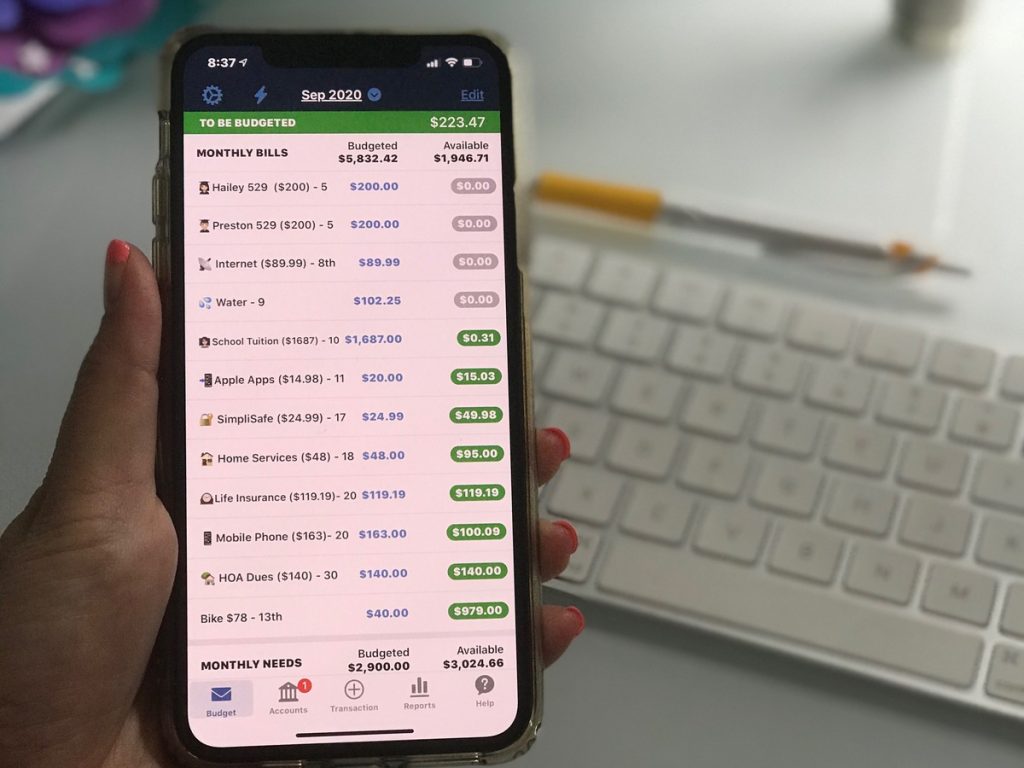
My family uses a quick and simple app called, YNAB. YNAB stands for You Need A Budget and it’s personal budgeting software available for Windows, Mac, and iOS. What I love about YNAB is that it’s super simple for me to divide and budget our funds into different categories. Then my husband and I can see what we have left to spend by simply looking at the app on our phone.
In the app, we set categories for all of our monthly expenses. When you add your budgeted amount to each category, it is automatically deducted from our monthly total. This might seem like a lot of work, but it’s really so quick and easy. Each month, it only takes me a matter of seconds to update our budgeted amount for each category, as opposed to all of the time it would take with cash envelopes.
Best yet, it updates instantly on all connected devices so my husband and I can both see, at all times, exactly how much money we have left in each category.
Hopefully, now you have a better understanding of a way to budget that is different from using cash envelopes and you can see if, maybe, this is a system that you would prefer. Let me know, which system has worked for you in the past or which system you think would work best for you and your family.
Do you like the idea of having access to your budget on an app on your phone at all times? I’d love to offer you a done-for-you/done-with-you family budget program! One where I will hand deliver a fully set up and organized YNAB budget plan based on your flow. I’ll work side-by-side with you to develop a routine and process to keep you on top of your family finances once and for all. Schedule a free 15 min call with me! Find out if we’d be a good fit and how I can help make it happen for you!
Did you ever start budgeting, just to end up too overwhelmed and then quit? Don’t feel bad if this is you, it’s so common! But that doesn’t have to be your story.
When my husband and I were first married, we found ourselves quickly buried in debt. Budgeting helped us to get out of over 120K in debt. But it took a lot of trial and error. I’m hoping that some of you will be able to learn from the missteps we made at the beginning.
If you are thinking about getting started with budgeting or if you’ve started before and quit, I want you to be successful from the start this time! Check out the top reasons people quit budgeting just after they start. You’ll be able to see the challenges and face them head on.
Here are the top 3 reasons people start budgeting but then end up quitting:
You just don’t know where to start.
You’ve heard all of these ways that other people are successfully budgeting, like cash envelopes, zero based budgeting, apps, and spreadsheets. You’re hearing it all but it’s overwhelming and it’s making you freak out. You just can’t figure out where to start.
There’s a lot of information out there to sift through and it absolutely is overwhelming. It’s hard to know what is the right system for you and your family. Because of the information overload, many people try and quit, or worse yet, they don’t even start.
You don’t have a solid foundation set up.
Many people who have the best intentions and really want to have a solid successful budget just don’t have the foundation in place to get started and stick to it. Before you even start budgeting, you need to get into the right mindset. Ask yourself why you want to budget. To be successful, you really have to know that piece. If you don’t have a clearly defined “why” your budget will continue to be low priority.
You start with a tool, process, or system that doesn’t work for you.
So many families start budgeting but they get started using the wrong tool, process, or system for their family or household. Obviously there are tons of different ways you can budget successfully but not every way is going to work for every family.
Before starting, it’s important to really consider the different options and what will work best for how your family operates. Make the best choice for your family, but also remain flexible and open minded. That way, if the system you chose to start with doesn’t work out for you, you can seamlessly move to a better fitting system.
What’s worked for my family:
The system that my husband and I have used to manage our household finances since 2013, when we got ourselves out of debt (and kept ourselves out of debt for all these years), is a system called YNAB. YNAB stands for You Need A Budget and it’s personal budgeting software available for Windows, Mac, and iOS.
YNAB is a system but it has helped us to create a routine and process for us and our household that works really very well. I would LOVE to show you how to use it as well.
If you are overwhelmed and you’re looking for a quick and easy way to get your household finances on track with a plan, we should chat.
Do you like the idea of a done for you/done with you family budget program? One where I will hand deliver a fully set up and organized YNAB budget plan based on your flow. I’ll work side-by-side with you to develop a routine and process to keep you on top of your family finances once and for all. Schedule a free 15 min call with me! Find out if we’d be a good fit and how I can help make it happen for you!
I’ve always known that we all possess certain behaviors around money. But, I never knew someone had actually coined these into personality types until I started reading Money Harmony by Olivia Mellan and Sherry Christie.
I’m always looking to learn new things to better myself and so that I can share them with others. According to the ladies who wrote Money Harmony, there are 9 money personality types. Now, we can all possess a combination of these money personality types. It’s not that one is good and one is bad, what we want is balance. Everything in moderation is the goal!
Here are 5 of those personality types and how you can use them to grow a healthy relationship with money for yourself and your family:
The Spender
Everyone can usually relate to this from time-to-time, especially if you’re someone with a bit of debt. Spenders are also often impulse buyers. You might have a tendency to spend a little too much and then feel guilty about it. It’s a cycle of spending followed by guilt. It can also cause some tension and friction in the family.
If you’re a spender, you can find a friend or accountability partner to help you out with this. Put them on speed dial and give them a call next time you’re ready to make an impulse buy. Take a step back and have your friend talk you through it.
You can also have a portion of your paycheck automatically transferred to your savings account. Now, since it’s deposited automatically, it’s done and you don’t even have to think about it!
The Hoarder
This person likes to save and doesn’t like to spend. You definitely don’t like to spend on yourself and you especially aren’t buying frivolous stuff! You’d prefer to save for a rainy day. We all want to save, but you need to be aware of if it is causing friction between you and your family or friends. If that’s the case, you’ll want to take a look at your habits.
Consider once a week spending $20 on a treat or a snack you can enjoy right then and there. Or, once a month, spend $25-$50 on a gift for someone you care for. See how that makes you feel and make note of what it brings up for you.
Giving to others can feel nice and balance out your tendency to save too much all the time. It’s great to save, but it’s also okay to splurge from time-to-time. Don’t feel guilty about that!
The Money Avoider
If you are so overwhelmed with your finances that you don’t have any idea about your money situation, this might be you! You don’t know what’s coming in or what you owe, this can get messy really quickly.
Reach out to a family member or friend who is good with money. Maybe even a professional who can help you get organized. It’s okay to start slow to get a handle on your finances. Maybe just choose 3 bills to start with. List out how much you owe and the due date and start to track them on the calendar on your phone. Each month, add on another bill and eventually you will be on top of everything you owe!
The Money Monk
This person thinks that money is evil or that you are not worthy of having money. What these people usually end up doing is self sabotaging. So, subconsciously you self sabotage to the point where your life is suffering.
It’s nice to be generous and to give back, but if it’s to the extreme that it’s harming you, that’s not good.
If you’re a money monk, try to think of people that are wealthy and doing really good things in the world. Ask yourself what qualities you admire or respect in those people. Then ask yourself what you have in common with those people. Chances are, you’ll find that they are generous and so are you. It will help you see that being wealthy isn’t bad. The more wealth you have the more you can do for others. It’s all about a simple mindset shift.
The Amasser
This is your workaholic – they eat, breath, and live for work! They feel they can never have enough money even if they live a comfortable life. They’re never satisfied with what they have. When they go on vacation with their family, they are always working. This type of behavior will cause friction within the family.
If this is you, you can make sure that all of your work is taken care of before going on a trip. If that sounds like too much, start out with just one day where you put all your focus on your family.
I’m guilty of this one myself. I get so engrossed in my work that I tune everyone and everything else out. Then, I feel bad about it. You can ask your kids and family how they perceive your relationship with work. The last thing you want is for your kids to only see you working. Then, they may grow up thinking all there is to life is work.
Do you see yourself in any of these money personality types? Are you one or a combination of a few? How about your spouse? If you and your spouse have different money personalities, that can be good! You can balance each other out.
Looking for help setting a family budget that works for all of the different personalities in your house? Book a FREE 15 min call with me to find out how I can help you with your budget plan. To schedule your call, click here!
Struggle with staying on top of your bills and budgeting?
Do you stress out and dread when the 1st of the month rolls around?
Tired of living paycheck to paycheck?
Have constant arguments with your spouse around the family finances?
Have no clue on how to even get in control of your financial life?
Download this FREE Monthly Budgeting Action Plan, which includes Worksheets with step by step instructions on guiding you exactly on what you need to do to set up your own family budgeting plan that works for you and your family.
Struggle with staying on top of your bills and budgeting?
Do you stress out and dread when the 1st of the month rolls around?
Tired of living paycheck to paycheck?
Have constant arguments with your spouse around the family finances?
Have no clue on how to even get in control of your financial life?
Download this FREE Monthly Budgeting Action Plan, which includes Worksheets with step by step instructions on guiding you exactly on what you need to do to set up your own family budgeting plan that works for you and your family.
Do you struggle with getting your kids to clean up their room?
Are you ready for your kids to be more responsible?
Would you like your kids to be able to manage their time better?
Ready for a simple way to teach your kids good money management habits?
Download this FREE Family Chore and Money System Action Guide. It includes worksheets with step by step instructions on guiding you exactly what you need to do to set up your own chore, schedule and money management plans.




 Being prepared in our finances can empower us because it impacts all of the areas of our life. Knowing this simple fact led me to put together a five phase journey based on my own experience with finances and the experiences of those I’ve helped along the way. My hope is that this framework will show you the path to financial freedom.

 Most people grow up not learning money lessons from their parents. They have to go through life and learn it the hard way, like I did. I learned from my parents to just – work, work, work, save and not spend. That can be a money lesson but I’m here to encourage you to teach your kids to manage their money more effectively.

 Are you currently paying your kids to take care of certain jobs around the house? Or do you give your children a weekly allowance without requiring them to do anything to earn that money?
 Recently, I interviewed a real life Fire Captain about all things fire prevention and what to do if a fire does break out. We broke the interview down into a few blog posts so that you can easily find the information you are looking for.
 This world can be a scary place. The news is full of stories that tell us all of the awful things that can happen in the blink of an eye. I try not to live in fear but, at the same time, I don’t want to be naïve, either. It’s always best to be as prepared as we can possibly be for any situation. That’s why, a while back, I took a street tactical self defense class with an instructor who is ex-law enforcement and military.

 Recently, I was honored to interview a Paramedic Fire Captain Live on my Facebook page. BTW, this fire captain is pretty special to me. He’s my hubby, Dave Nguyen! He became a paramedic in 1998 and he joined the department as a firefighter in 2002. He’s worked in busy areas, has seen many different types of calls and he

 Do you use cash envelopes? Or do you know someone who does? Or maybe, like me, you’ve tried it and hated it!
 Did you ever start budgeting, just to end up too overwhelmed and then quit? Don’t feel bad if this is you, it’s so common! But that doesn’t have to be your story.

 I’ve always known that we all possess certain behaviors around money. But, I never knew someone had actually coined these into personality types until I started reading