Being prepared in our finances can empower us because it impacts all of the areas of our life. Knowing this simple fact led me to put together a five phase journey based on my own experience with finances and the experiences of those I’ve helped along the way. My hope is that this framework will show you the path to financial freedom.
Knowing where you are at and which direction you’re heading in is vital to moving towards where you ultimately want your end destination to be. These are the five phases we went through. If you can identify which of the behavioral phases you are in, you’ll also be able to identify the steps you need to take to move forward on your journey.
Wondering which phase you are in? Check out my 5 behavioral phases of the finance journey!
Phase 1 – Denial
This is where most people begin their financial journey. When my husband and I were first married, we were definitely in denial about our finances. We thought we had all of the money in the world and we were spending on credit like there was no tomorrow. We racked up debt on over 11 credit cards. Since we could afford the minimum payments on them, we thought we were fine. You know the motto, “Buy now, pay later”? That was us. Trust me, we sure did pay later!
We were in denial that we couldn’t really afford these things. We were in denial that we had a spending problem.
Phase 2 – Avoidance
In this phase, you start to recognize that you have a spending problem, but you’re doing things to avoid the issue because you don’t want to deal with it. But, at the end of every month, you need to come up with money to pay the bills and you’re noticing that your credit cards are maxed out.
For us, we had our 11 credit cards, and we found ourselves signing up for new credit cards each month with 0% interest rates. Then, we would transfer our balance from one credit card with a high interest rate to this new low interest card. Essentially, we were just moving our problems around – not solving them.
This process took care of some of the fees, but it didn’t solve the actual problem – which was our spending. We knew there was a problem, but we were avoiding it. We didn’t want to address it.
Phase 3 – Frustration
Eventually, if you are stuck in the denial or avoidance phases for long enough, you will start to get frustrated with your lifestyle. Living paycheck-to-paycheck, being tired every month of not knowing where all of your money is going, and having those arguments every month with your spouse or partner about money are just so frustrating.
That level of frustration at not knowing where your money is going, being disorganized with your finances, and over spending will start to build up and catch up to you. For myself and my husband we were in the avoidance and frustration phases for a long time. We finally decided enough was enough and we didn’t want to be stressed out and frustrated anymore. This led us into the next phase.
Phase 4 – Exploring
Once you’ve decided that you’ve had enough of the stress and frustration, you’ll begin to explore your options. We knew we needed to do something so we started to look at our situation and considered getting outside help. We took a good hard look at our lives and began to think about what it is that we wanted for our future.
Whether or not you do this yourself with all of the resources out there, you ask family and friends for tips and suggestions, or you get professional help, it’s important to find a solution to the problem you are having and begin to work on the issues. And this slowly moves you towards the final phase – the place where we all want to be!
Phase 5 – Control
The final stage brings us confidence and control. This is where we all hope to end up with peace of mind and stress free living. This is what we all want for our lives and our families.
Ask yourself – which phase are you in now? This might sound crazy, but if you are in the frustration phase, this is a great place to be! Here’s why: If you are frustrated, you’re likely ready to take action and make a change.
Now that you’ve identified which of the behavioral phases you’re at, it’s time to make a plan to move you along on your journey. Lucky for you, I can help with that! Let’s set a time for us to chat about how we can get you in control of your finances!
I have to admit, years ago, there was a time in my life when I exhibited all 10 of these signs of financial struggles. It started right around the time my husband and I got married in 2006. We were spending, spending, spending – and we had no idea how bad of a situation we were getting ourselves into. Honestly, I don’t even know what we were spending on. We had multiple credit cards open and we were racking up the debt faster than we could pay it off!
In the beginning, we were only experiencing 1, or 2, or 3 of these signs, but before we knew it, we were experiencing almost every single one.
Does this sound familiar?
If this sounds like you, I want you to know, you are not alone and even reading this shows me that you are heading in the right direction. In order to resolve and take care of an issue, you need to acknowledge it. My hope is that you’ll see these signs and if you recognize them in yourself, you’ll make the decision to take action before things get too far along.
Here are 10 signs financial struggles might be creeping up on you:
You Don’t Know How Much You Owe
Credit cards, loans galore – it can be so overwhelming. Do you feel like there’s just so much, you decide to push it to the back of your mind and ignore it or pretend it’s not there? If that’s you, the financial struggle is real.
You’re Arguing with Your Partner About Money
When arguments continually center around money, finances, and spending – your financial struggles are a real problem.This arguing can start out small and escalate, especially if one person is a saver and the other is a spender. When both spouses aren’t on the same page about spending, it results in tension and, over time, this tension puts a strain on your relationship.
You Need to Use Credit Cards to Cover Expenses
You know you don’t have money in the bank but you’ve got a handy-dandy credit card in your pocket. So you buy now and pay for it later. This leads to rapidly racking up credit card debt. It’s time to really look at your finances if you always find yourself relying on your credit cards.
You’re Only Able to Make Minimum Payments
If you are only able to make the minimum monthly payments on your loans and bills, it is a sign that your finances might not be where you need them to be. When you have multiple credit cards and loans, those minimum payments add up and the balance never appears to get smaller due to interest.
You Frequently Make Late Payments and Overdraft Your Account
When you miss a payment or overdraft your account, you’ll get hit with loads of extra fees. No one wants additional fees – they really start to add up. And, mounting fees and charges will just add to your debt. If this happens to you frequently, it is definitely an underlying issue you’ll want to look at.
You Don’t Have a Savings or Emergency Fund
Emergencies happen, things break down, so it’s important to have a plan and some funds set aside for those unforeseen events and accidents. Without a savings or emergency fund, you’ll end up taking out more loans and using your credit cards. It can take a while to get to a place where you can set up a savings fund but the sooner you’re able to do this, the better off you’ll be.
You Find Yourself Borrowing from Family and Friends
When things are bad, you might feel like you have no other option than to rely on family and friends. Fortunately, this wasn’t a huge issue for us. If you rely on friends and family to bail you out, it is time to start establishing new financial habits to move towards financial security.
You’ve Requested an Increase on Credit Limits
Credit cards have limits to help us from not racking up more debt than we can payback. If you’ve hit that limit and you’re requesting more credit, that’s not a good sign. This goes hand-in-hand with opening up multiple credit cards. Or, have you found yourself getting creative with moving balances and debts from one place to another? If this is you, it might be time to take a good hard look at these habits.
You Have No Retirement Savings
This isn’t necessarily a sign you’re struggling, but it is something you want to start thinking about. I’m sure you don’t want to be working until you’re 80 or 90 – no one does! But if you are getting closer and closer to retirement age with no financial plan, you’re going to find yourself experiencing financial struggles. The later you start saving for retirement, the more difficult it will be to grow your funds into something you can live off of.
You’re Living Paycheck to Paycheck
If this is you – you get paid and you’re already relying on your next paycheck. If you’re in the vicious cycle of using your paycheck before it even hits your bank account, that is a really strong sign that you are struggling financially.
Take a step back, lay everything out, take a look at your situation, and be honest with yourself. Acknowledge and be aware of what is happening in your life and your finances. It is going to be okay. Now, let’s take some steps to move your family forward to a better financial space.
I’m holding a FREE live online Family Budget Planning Workshop at the end of August and I’d love to have you join me. Click here for all of the details so you can begin to manage and control your family without the overwhelm.
The new year is the perfect time for goal setting and dreaming big. For us, one thing that goes hand-in-hand with those two things is updating our monthly budget. My husband and I decided a while ago that talking openly and honestly about our finances is a must for our family. Sometimes this involves talking about how we can cut expenses or find creative ways to bring in more income.
I think it’s safe to say, we’d all love to have a little extra spending money in our pockets. And for some of us, we need more money each month just to make ends meet. No matter which category you fall into, there are some truly genius tips and tricks out there to cut back on your monthly expenses and increase your income.
Here are our top creative ways to cut expenses and increase your monthly income:
Ideas to cut expenses
Bundle or eliminate monthly bills:
Cancel cable and opt for a few, cheaper streaming services. Hulu offers a lot of network programs the day after they air on cable. Disney+ will keep the kids happy for less than $6 a month. This combined with Hulu comes out to $12 a month as opposed to the average American cable bill which is $107 per month.
Bundle your cable, internet, and phone bill. If you’re not ready to cancel your cable, consider combining it with your phone and internet into a single “Triple Play”. This type of offering can drop your combined costs to as low as $79.99. Another pro tip – if you purchase your own router and wireless modem you will eliminate some of the additional monthly fees you see on your cable bill.
Cancel your gym membership. If you aren’t using it, let it go. If you do use it, but only occasionally, think of creative ways to get in a workout without shelling out a monthly fee – like jogging, hiking, or cycling.
Bundle your home and car insurance. Many insurance companies offer significant discounts for bundling your car and homeowners insurance. Shop around for the best offer you can find with maximum coverage for your protection.
Groceries
I know you’ve heard of couponing, but have you actually tried it? On average, shoppers using coupons can save $30-$50 a week. Additionally, make sure that you are signed up for the rewards and discount cards at whatever store you grocery shop at.
Buy in bulk – Costco, BJs, Sam’s Club – they all offer bulk groceries at great prices. If your shopping for a small family, ask a friend to split the cost and the products.
Shop at discount stores like Aldi. Just because you are looking to cut your expenses, doesn’t mean the quality of your groceries has to suffer. Aldi offers organic and local produce at an incredibly discounted rate. They sell the Simply Nature brand which is both high quality and organic.
Buy store brand groceries. Often times, the quality and taste are virtually the same as their name brand counterparts.
Spend Less on Food and Drinks
Don’t stop for coffee. Make it at home. Depending on if you get your morning brew at the gas station, Dunkin, or Starbucks, you could be saving yourself anywhere from $1 to $5 a day.
Pack your lunch. This option will always be cheaper than eating out or ordering in. Just consider how different the cost would be to prepare and pack a salad from home vs. buying a pricey salad from a local lunch spot.
Limit dinners out. Review your budget and decide exactly how much you can spend each month on eating out or ordering in. You’ll find this helpful in budgeting for your dining out expenses.
Ditch your car (when you can)
Whenever you are able to opt to cycle, carpool, or walk instead of driving your car. The benefits here are huge. First, you’ll save on gas. You lower your likelihood of being involved in a costly automobile accident. You’ll lower the amount of pricey maintenance and wear and tear on your vehicle. And, remember that gym membership you cancelled? Well, use this as an opportunity to keep fit.
Ideas to bring in extra money
Teach Classes Online
With the growth of the internet, there are so many opportunities to teach online. If you happen to have a teaching license (from any US state) you can teach content at an online school like K12 or ESL at VIPKid.
Check out Teachable or Udemy for vocational courses. I’ve recently seen course offerings on needle point, cake decorating, and scrap booking. With limited technological know-how, you can offer your own course based on your hobby in no time.
Freelance
If you have a marketable skill, like, writing, graphic design, or web development, you can offer it as a freelancer. If you work full-time or part-time, consider picking up some clients on nights and weekends. If you’re a stay-at-home mom, you can always try doing some work early mornings, during nap time, or after the kiddos are in bed. Check out sites like Fiverr, UpWork, and The Mom Project.
Sell Gently Used Items Online
There is a huge market for selling gently used items. My first stop is always Facebook Marketplace, but there are tons of apps for it, too. Check out Mercari and LetGo – they both come highly recommended. And, don’t rule out old standbys like Craigslist and Ebay.
Sell a physical product
For us, it’s our PreparaKit first aid kits. As a nurse, encouraging safety in families is something that is tremendously important to me.
However, you don’t need to start out with something this involved. With sites like Etsy, you can sell almost anything you make – jewelry, apparel, home decor, the possibilities are endless.
Whether you need to cut expenses and bring in more income or you’d just like a little extra money each month for a safety net, I encourage you to check out our Free Family Monthly Action Plan. This Monthly Budgeting Action Plan offers step-by-step instructions to guide you through the exact steps you need to take to set up your own family budgeting plan.
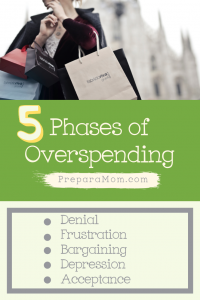
If you’re reading this, I’m guessing you fall into one of two categories. Either you’re on top of your finances but you’re a little curious to learn more about the five phases of overspending or you know you have some spending issues and you want to figure out where you fall within these five phases.
If you want to get ahead of your finances, you absolutely need to be aware of these 5 phases of overspending. It’s crucial that understand the impact that moving through these phases will have on you and your family if you aren’t on top of it.
Let’s break it down and jump into each of these phases one-by-one.
Denial
Those who are in denial think, “If there’s money in the bank, spend it.” The denial phase is full of over spenders. If you are an over spender, it’s time to take a hard look at yourself in the mirror. You may be in denial.
People in this phase don’t have a care in the world about what they spend. They spend like crazy with no limits or worry. The denial phase is characterized by a buy now and deal with it later mentality.
If you’re in this phase – you need to wake up! This is the worst place you could be.
Frustration
Eventually, you get to the point where living paycheck-to-paycheck no longer works. There are bills to pay but you don’t have the money to pay them. You’re 2 days away from payday but you have a bill due now. So, you need to go to a check advancing place or you need to borrow money from friends and family.
This is frustrating. It’s frustrating because you don’t have the money in your bank account but you know it’s coming.
You may cycle through the denial and frustration phases for a while because once you get the money and pay the bill, you will move right back into the denial phase. Something needs to give.
Bargaining
Here, you know you have cycled through denial and frustration for a while. Then payday comes around. Now you’re bargaining with yourself. You know you should pay back the money you owe or pay down your credit card debt, but you convince yourself that you need to spend the money on something. You convince yourself that you’ll pay everyone back with your next paycheck. You have the money and you really want to treat yourself so you do. You tell yourself it’s okay to spend the money because you have it. You can always pay off your debts later.
Depression
After all of the denial, frustration, and bargaining, you’ve spent too many nights lying awake reflecting on your life and why your accounts are empty at the end of the month. The constant cycle has put a strain on your relationships because you are always fighting over money. You’re going to work to earn money but you aren’t happy. It isn’t paying enough.
This endless cycle continues every month and you ultimately start feeling the stress. You start feeling sad, helpless, and depressed about your financial situation and it starts to bleed into other areas of your life. This is not where you ever pictured you’d be and you hate the way it feels.
Acceptance
Finally, you get to the acceptance phase. You accept the fact that you have money issues, that you need help and that you are ready to do something about it. You’re sick and tired of being frustrated and depressed about your money situation. You finally get to a point where you’re fed up with living paycheck-to-paycheck, having no money and/or being in debt. You’re now ready to make some drastic changes to get yourself out of the mess you’ve made.
This is when you really begin to turn your life around. Stop living paycheck-to-paycheck. Pay off debt. End the constant rat race.
For our family, it took hitting this stage to finally decide to take action to eliminate our debt through research and seeking help.
Be real with yourself and accept where you are at right now so that you can do something about it. If you’ve reached the acceptance stage and you’re ready to take action, check out our Free Family Monthly Action Plan. This Monthly Budgeting Action Plan, offers step-by-step instructions to guide you through the exact steps you need to take to set up your own family budgeting plan.
As moms and parents, there are so many decisions to make every day and if one of your New Year’s resolutions is budgeting, the question, cash envelopes vs digital budgeting, which will work better for you? Do you do better with a DIY approach to budgeting or should you seek technological assistance?
So many choices, so many decisions, but at the end of the day you need to pick what works for you. Some people need to see the money and feel it, in order to truly understand its value. Others just like the convenience of not having the cash physically in their hands, but having it conveniently located in the cloud or in apps that are more conducive to their busy lifestyle.
Compare Cash Envelopes vs Digital Budgeting:
Finance software can be convenient if the app or program lets you automate savings, or access and update your information on the go. If it doesn’t automatically input and categorize your purchases or it’s hard to use, it might not add much value.
For some, pen and paper is best or a chart method that you can keep on your refrigerator. Let’s face it, some of us do come from a generation when computers were not the norm and apps didn’t exist yet. It has actually been proven that writing things down can help you retain information and feel connected to your budget. If you’re just not comfortable with the concept of linking your bank accounts to an electronic budgeting service, a physical method can save you worry, too.
The Pros of the Cash Envelope System:
It works! It can really keep you on track, because you are physically holding the money in your hands every day and keeping it in the envelopes. Sometimes touching and feeling the money, makes us feel it’s worth more than when it’s somewhere online or in the cloud.
This cash envelope system truly forces us to be disciplined
You will not have overdraft charges. We know how easy it is to overdraw your account, if some additional automatic payments go through that you were not expecting.
The Cons of the Cash Envelope System:
You need to carry a lot of cash. The traditional envelope system requires that you use cash most of the time for any additional purchases beyond paying bills online or with checks. If you’re forgetful this could be a potential problem when you want to buy your child an ice-cream cone or you need gas in your car.
Envelope budgeting requires that you stick to a very strict budget with a small grocery budget and clothing budget. If you have a Type A personality this works great, but otherwise it can be really stressful.
If you eliminate credit cards, you are unable to take advantage of credit card rewards. If you are the type of person who can be in control and not overspend, then credit cards have tremendous reward benefits like cash back and extra gas money.
Sticking with different categories can be really hard. For instance, if you go to Target and your kids want to buy their weekly gift from their allowance money, but you also saw a coffee maker you need or a new shirt, then all of these purchases fall into different categories. You have to use different envelopes for each transaction, and this could be really frustrating not only to you but everyone else waiting in the line behind you.
Using cash for envelope budgeting also increases the chance that you might accidentally lose money.
For some of us, the cash system is outdated in a tech-savvy world filled with apps, credit cards, online spending and other tech-driven budgeting tools.
The Pros of the Digital Budgeting System:
There are a variety of different apps at your disposal, that you can conveniently download to your phone or access online to keep track of your spending. A popular app to try is Mint, which is one of the oldest and best-known budgeting apps. YNAB and Every Dollar are other helpful tools to build your budget based on your income and gives every dollar a job within your budget.
You don’t have to worry about losing cash on hand, if you tend to be forgetful or disorganized.
There is no need to write down balances or manually track your spending, because it is all done for you automatically within the apps.
If you’re self-employed, digital budgeting software allows you to print off category lists of expenses that you can hand over to your accountant at tax time (this will make you a CPA’s dream client.)
The Cons of the Digital Budgeting System:
Technology can be our best friend, and at times our worst enemy. If the app suddenly freezes, you lose your phone, or you drop your phone in a puddle and it no longer works, your digital budgeting strategy is thrown out the window. You will have to remember to write down the things you couldn’t update within your app, and remember to update it later in the digital budgeting app of your choice. You have to create positive habits to update your apps, so everything is current.
Many people have concerns over the security level of apps and programs that integrate with our bank accounts, even though most of these programs use high-level security encrypting. A security breach is always a possibility, which could put your information at risk.
As most of us know our virtual money, makes us less-inclined to see the real value of our money when it is being virtually withdrawn from our bank accounts for bills and other purchases. It makes it easier for us to buy an item online just by clicking a button, instead of actually counting out the cash and handing it over to make our purchase. We tend to spend less on frivolous items if we are seeing the actual transfer of cash.
There are advantages & disadvantages to both methods, so you have to decide what’s right for you. Unfortunately we’re not all fortune tellers by trade, and it’s hard to predict what may or may not happen when it comes to money management. We are now living in a digital age whether we like it or not. That’s not to say we can’t go back to tried and true methods that worked for generations before us…after all, Warren Buffet was a product of a former generation and learned to budget pretty nicely.
Decide what works best for you – cash envelopes vs digital budgeting. It’s your money, your budget, and your call. No matter the method you choose, the real goal is to save money and teach your family how to do the same by making you more prepared before you spend your hard-earned money.
‘It’s the Most Wonderful Time of the Year,’ (as the song goes) and that means we have holiday decorating, lots of shopping, to-do’s that go on for miles, holiday menus to plan, parties, and some will be planning their holiday travel on a budget to visit their friends and loved ones. If you are one of the lucky ones who will be singing that tune called ‘I’ll Be Home for Christmas’ this holiday season, you might also be wondering how you can afford it.
Traveling during the holidays to visit friends, relatives and loved ones can be super expensive, and sometimes just that extra dose of stress that we don’t need during this time of year. Don’t get me wrong, I look forward to this magical season, but I also think it’s important to be prepared and plan accordingly to stick to our family budget while we have fun at the same time.
If your family will be traveling for the holidays, here are some helpful tips to make it an unforgettable holiday that you will want to ‘remember’ instead of ‘forget.’
1. Book Last Minute
This might sound strange, but it’s already December and a little too late to be thinking about booking your last-minute travel plans in advance. The good news is that it might be better for your wallet. A local hotel owner or Bed & Breakfast, will be much more likely to agree to a discount if they are unlikely to sell the last bed to someone else. Or, while they may not drop the price, perhaps you can persuade them to upgrade your room or throw in a free spa experience that every mom can use this time of year.
The same goes for booking flights, rental cars, and tickets for special attractions at your destination of choice. I know friends who have found last-minute $300 flights from NYC to Paris for the holidays, while others have been upgraded to a Mercedes convertible rental car for the same price as a minivan. Winning! So it can be done!
2. Take Advantage of Apps
Gone are the days of sorting through individual hotel or airport websites. Now, aggregator apps can do most of the work for you. Find your lodging through Hipmunk https://www.hipmunk.com/, which searches hundreds of major travel sites. Figure out your fuel coast with Gasbuddy’s trip calculator https://www.gasbuddy.com/. And find the best airline deals and the best times to fly and buy with Hopper https://www.hopper.com/.
3. Think of Your Trip as a Gift in Itself
If you have older kids and teens, they should be able to appreciate that a family trip during the holidays costs money and can really be considered a gift in its own right. Help your kids understand the gift of travel, and allow them to plan a portion of your vacation and pick one special activity each. If possible, try to spend a day doing each child’s special outing of their choice. Another option is to gift kids souvenir money instead, (in the currency of your destination if traveling abroad) and don’t put any restrictions on how they spend it.
4. Consider Gift-Giving in a New Way:
Let’s be real. Chances are you won’t have a lot of room in your carry-on luggage to bring gifts if you will be opting for air travel, or you may not even have enough room if traveling by car. You can always try gift-giving on the go! Simply draw a family member’s name and shop for them while you’re traveling.
Try to focus on smaller, stocking-stuffer type gifts and gift your kids with one smaller gift each day during your trip, instead of giving all gifts on Christmas morning. Small toys, crafts, goodies, and games they’ll use during your travels, are excellent ideas. For those celebrating Hanukkah, this ‘new’ system will feel even easier to implement.
5. Ship Your Presents
If you can’t get around buying everyone on your list a smaller gift, then thank goodness for‘Santa’s Magic Sleigh.’ Instead of paying annoying baggage fees or renting a semi-truck to hold all of your stuff, take advantage of free shipping deals as soon as possible to send the presents to your destination. Your suitcases will be smiling, and your kids won’t be sitting on the floor of your car trying to find a place to sit for the road trip.
6. Use Gift Cards and Points
Cardpool https://www.cardpool.com/ and Raise https://www.raise.com/ are great sites for finding discounted gift cards with leftover cash on them. Buy several and use them to pay for your flight, hotel, rental car or a few restaurant meals while you’re on the road.
7. Let Santa Know
A recent study by HomeAway has shown that 84% of families will spend the holidays together. But traveling to be with family can have its difficulties. Kids worry that Santa won’t find them, which causes unnecessary stress during a festive vacation. Check out: Message from Santa!https://apps.apple.com/us/app/a-call-from-santa/id933921849! They have solved this problem for parents. Just download the app with your iPhone and let your child leave Santa a voicemail telling him where you’ll be for the holidays and Santa will find you!. This app also comes with a lot of different cool features such as personal video messages from Santa, a phone call from Santa, and even send a text message and he’ll reply instantly! Even Santa needs to take a break once in a while from the elves.
8. Pack Snacks
We all know the minute you get everyone in the car for a road trip, someone is going to get the munchies. If you start filling up on snacks at every gas station or pit-stop, you’re going to run low on travel funds quickly. Instead of buying those unhealthy snacks like chips, candy, and soda at convenience store prices, make sure to pack your snacks before you hit the road. Bring popcorn, pretzels, juice packs, bottled water etc., so everyone can snack healthy and be less cranky at a fraction of the price.
9. Be Flexible
The secret is out! We all know that flying or driving on Christmas Day, can be a great budget-saver. Not only does it reduce stress, but it means cheaper flights and fewer gas-depleting traffic jams! Entertain the idea of traveling on this day if possible, and give your loved ones a ‘Christmas Miracle’ when you ring their doorbell on Christmas Day!
10. Buy Less Stuff
Even though we may not want to hear it, in order to save money…you have to buy less stuff. Always remember, the most important thing about the holidays is spending quality time with our friends, family and loved ones. No amount of gifts, decorations, or fancy hotels will ever replace that. Your presence alone will be the most memorable gift you could ever give.
Enjoy the holidays this year, while implementing these ten budget-friendly holiday travel tips. When you do, you’ll enjoy the holidays and your much-needed family vacation!
Struggle with staying on top of your bills and budgeting?
Do you stress out and dread when the 1st of the month rolls around?
Tired of living paycheck to paycheck?
Have constant arguments with your spouse around the family finances?
Have no clue on how to even get in control of your financial life?
Download this FREE Monthly Budgeting Action Plan, which includes Worksheets with step by step instructions on guiding you exactly on what you need to do to set up your own family budgeting plan that works for you and your family.
Struggle with staying on top of your bills and budgeting?
Do you stress out and dread when the 1st of the month rolls around?
Tired of living paycheck to paycheck?
Have constant arguments with your spouse around the family finances?
Have no clue on how to even get in control of your financial life?
Download this FREE Monthly Budgeting Action Plan, which includes Worksheets with step by step instructions on guiding you exactly on what you need to do to set up your own family budgeting plan that works for you and your family.
Do you struggle with getting your kids to clean up their room?
Are you ready for your kids to be more responsible?
Would you like your kids to be able to manage their time better?
Ready for a simple way to teach your kids good money management habits?
Download this FREE Family Chore and Money System Action Guide. It includes worksheets with step by step instructions on guiding you exactly what you need to do to set up your own chore, schedule and money management plans.
 Being prepared in our finances can empower us because it impacts all of the areas of our life. Knowing this simple fact led me to put together a five phase journey based on my own experience with finances and the experiences of those I’ve helped along the way. My hope is that this framework will show you the path to financial freedom.

 I have to admit, years ago, there was a time in my life when I exhibited all 10 of these signs of financial struggles. It started right around the time my husband and I got married in 2006. We were spending, spending, spending – and we had no idea how bad of a situation we were getting ourselves into. Honestly, I don’t even know what we were spending on. We had multiple credit cards open and we were racking up the debt faster than we could pay it off!




 Those who are in denial think, “If there’s money in the bank, spend it.” The denial phase is full of over spenders. If you are an over spender, it’s time to take a hard look at yourself in the mirror. You may be in denial.
 After all of the denial, frustration, and bargaining, you’ve spent too many nights lying awake reflecting on your life and why your accounts are empty at the end of the month. The constant cycle has put a strain on your relationships because you are always fighting over money. You’re going to work to earn money but you aren’t happy. It isn’t paying enough.
 As moms and parents, there are so many decisions to make every day and if one of your New Year’s resolutions is budgeting, the question, cash envelopes vs digital budgeting, which will work better for you? Do you do better with a DIY approach to
 online to keep track of your spending. A popular app to try is
