Spring’s here and that means summer is right around the corner.
And, if you’ve been cooped up in the house during this long winter, then I’m sure you can’t wait to get out into the sun and snap out of your cabin fever.
If you’re planning some fun in the sun, you’re going to want to do everything you can to protect your kids from sunburns. A few bad sunburns as a child may seem like a temporary inconvenience, but they can increase your child’s chances of getting skin cancer when they’re older.
Let’s look at easy ways to protect your kids to stay safe in the sun:
Sunscreen
The general rule of thumb is that you need to apply (and reapply) sunscreen about every two hours you’re outside in direct sunlight.
Additionally, make sure that you’re using sun protection designated for UVA and UVB (broad spectrum) rays. Don’t forget to apply sunscreen to areas like the neck, ears, and face. Use sunscreen that’s waterproof (even sweat can wash off sunscreen) and reapply if you go into the water.
Clothes
An easy way to protect your child from the sun is by covering them up as much as possible. Now, I’m not saying put the poor kid in a hazmat suit that covers them from head to toe. But, if weather allows, have them wear long sleeves and pants when going outside to protect their arms and legs.
If you’re at the beach or the pool, invest in a swim shirt that has built-in UVA protection. You can protect your child’s face with a big floppy hat (or a baseball cap).
Although it may seem counter-intuitive, darker clothes have been found to provide more protection than lighter colored clothes. (Many people shy away from these because they think the darker colors attract the sun more.)
Finally, don’t forget to protect your child’s eyes with a good pair of sunglasses that offers UVA protection.
Shade
Use shade as much as possible! If you’re going to the beach, bring an umbrella or portable “beach tent” so you can get into the shade when the sun gets too hot.
Check with your child’s school to make sure they have a shaded area outside on the playground or the PE practice fields. The sun is at its worst during mid-day (specifically from about noon to 3 or 4 PM). If you can, get outdoors during the early morning or late afternoon and schedule indoor activities during this extreme time.
With a little planning and prep, the whole family can enjoy time in the sun!
No need to be afraid of the sun, especially for your children. Protecting them now, protects them later. It’ll give them lifelong habits that will help them take care of their skin and hopefully stave off skin cancer well into their adult life.
Supervision is key for young children and certain foods
When you’re feeding a small child, it’s important to supervise them. Don’t allow your toddler to walk around and eat. They should be seated and paying attention to what they’re doing. (A little kid can’t multi-task, so walking and eating at the same time can be dangerous – and messy!)
The real danger is that it only takes four minutes for a child to die from choking and even less time for permanent brain damage to set in. Be really cautious during these first years even while you are in the front seat driving, your child could be choking in the back seat.
What should I do if my child begins choking?
As hard as this may sound, stay calm. Freaking out takes away precious time and can keep you from focusing on the necessary steps to take.
Call 911 immediately and tell them that you have a choking child. Even if you dislodge the food, they can still come take a look at your child to make sure they are OK.
Be prepared by taking a CPR class with your local Red Cross or health organization. This will teach you the proper way to do the Heimlich maneuver on an infant or young child.
Choking is not something to play around with. Pay special attention to the types of foods your child eats and if you have any concerns, skip it and feed them something else. You can also be sure to help them with their digestion by cutting food into very small pieces for easy chewing.
When it comes to kids, accidents can always happen. This is especially true if you’ve got rambunctious little ones who like to tear around the house or the athletic field.
Since we can’t put them in head-to-toe bubble-wrap, we have to know what to do when an accident occurs. One of the most common types of injuries is a twisted ankle.
Is it a sprained ankle or broken ankle?
Sprains can hurt really badly and the first time a child experiences this pain, they may think they’ve broken their ankle. More than likely, you will find out it’s a sprain.
A sprained ankle is caused when the ligaments in your foot are pulled too much. Ligaments naturally have some “give” to them, but a sprain occurs when they are pulled too much sometimes causing them to tear.
There are actually 3 grades for sprains:
Grade 1—The least serious type, a grade 1 sprain is usually sore with some mild to moderate swelling.
Grade 2—In this type, the ligaments will tear partially, but not all the way. Putting weight on your foot is painful and the joint may not feel solid enough to support your body.
Grade 3—This one is really painful because the ligaments in your ankle are torn completely through. With a grade 3, you are looking at a longer recovery and you will not be able to support your weight on the foot for a while.
Broken ankle—This is entirely different as your bone actually cracks or snaps. With this, you won’t be able to stand at all and you will need a cast until the bones mend.
How do you treat a twisted ankle?
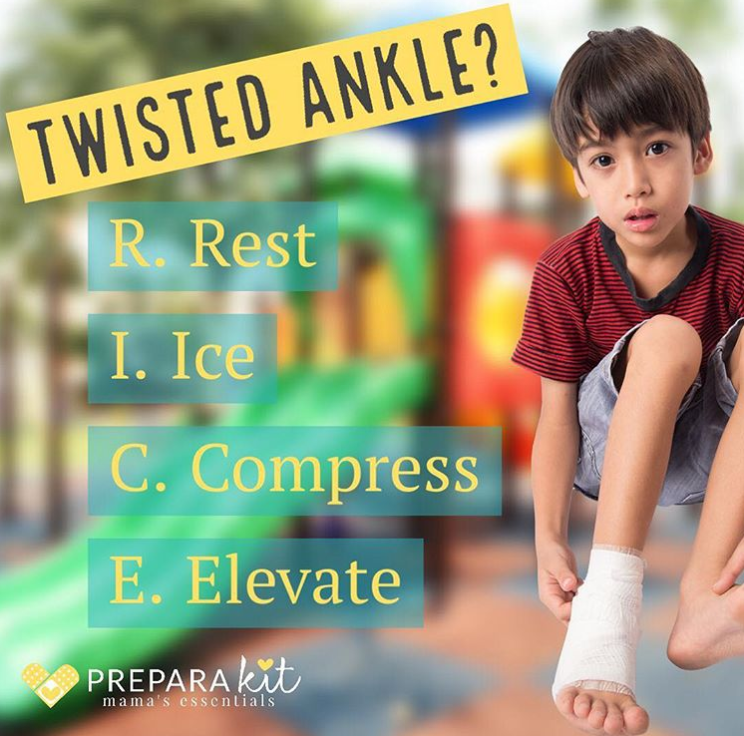
If you have twisted or sprained your ankle, you should try the R.I.C.E. method for treating it.
This stands for:
REST—Get off your feet immediately and take it easy. If you try to go back to playing or participating in a sport too quickly, you will likely re-injure it and make it worse. The first thing you need to do is just stop and rest.
ICE—You may have heard that you should put a heating pad on a sprain, but don’t. The best thing to do is put an ice pack on as soon as possible. Keep it on for at least 15 minutes at first. After that, you should do 15 minutes on, 15 off ice therapy for the first 24 hours at least, while they are awake of course. For the little kids, this is a long time so realistically, we like to say leave it on for as long as they can tolerate it.
COMPRESS—Apply an elastic bandage or support to your ankle to keep the swelling down. Be careful with this though. If you compress it too tightly, you may cut off circulation to your foot. Be sure you can slip a finger under the bandage.
ELEVATE—When you lay down, keep your foot elevated so that it is higher than your heart. This will help the swelling go down as fluid is drained off. This is especially useful to do at night while you are in bed.
Follow the R.I.C.E. method to help treat your child’s twisted ankles. But remember, if it is severe or if the pain and swelling persists, you should always follow up with a doctor.
Be Prepared for Sprains, Breaks and Twisted Ankles!
It’s an instinct for moms to want to protect our children—it’s built into our DNA. And if we see our child hurt or in pain, it’s also an instinct to fly into “mama bear” mode and try to take care of them. That’s why nosebleeds can cause such a panic with us.
But, unfortunately, it’s actually one of the health problems that can cause a panic induced reaction that can lead to the wrong treatment for your child.
Let’s take a look at what can cause a nosebleed and how to stop them.
There are several possible causes of nosebleeds in children. These include:
Dry air—This is the most common cause of nosebleeds in children. If you keep your home heated in the winter or if you live in a region that is especially arid, then your child’s nose can get really dried out. When this happens, it can lead to a nosebleed. My trick to combat this is to use Aquaphor to lubricate my kids nose at night using a Q-tip. Works really well!
Physical injury—This one is probably the scariest, because it happens suddenly and is coupled with fears of a broken nose. It happens often with sports by taking a ball or something similar to the face.
Nasal problems—If your child has a cold or allergies, then it can cause their nasal membranes to become irritated, which can lead to nosebleeds. Sinus or bacterial infections can also be to blame.
Nose picking—It’s gross, but let’s face it: kids pick their noses. Unfortunately, sometimes they scratch the inner lining of their nose causing it to bleed. This one is more common than many people think.
When your child gets a nosebleed, it’s going to be scary for them. Here’s how you can help treat the nosebleed and take care of them:
Have the child sit down and relax. This is important because their natural instinct is to run around and freak out. Sit down, hold their hand, and tell them that it’s going to be OK.
Have them lean forward instead of leaning back or laying down. This is a big one because many people were taught to hold your head back. This just causes the blood to go back down into your nasal passages—not a good thing. Instead, lean forward so that the blood can flow out.
Using gauze or tissue paper, pinch the child’s nose at the bony part right along the bridge. This is important because it will staunch the flow of blood. Make sure to also use the gauze or tissue to cover up the nose to soak up the blood and keep it away from clothes or furniture and carpets. If you have one handy, you can also place a cold compress across the bridge of the nose to help decrease the blood flow.
Tell your child to breathe through their mouth.
Apply pressure for 5-10 minutes until the bleeding stops. Keep the pressure applied and resist the urge to check very often. Checking every thirty seconds will prolong the time it takes to stop the bleeding. If it goes on for more than fifteen minutes, you may need to call a health professional for advice. If the nosebleed is from a physical trauma such as a blunt force injury, then you should call 911 or get medical attention as there may be some other issues at play such as a broken nose.
After the nosebleed stops, avoid any activity for 30 minutes that might cause it to start bleeding again. (This would not be the time to start back into the game and risk taking another shot to the nose.) Part of this is to keep your child from picking or blowing their nose. It’s only natural for them to want to do this to clear out their nose which is probably going to feel stuffy. But if you do this, it could start bleeding again.
Nosebleeds are a fairly common occurrence, especially with active children. If you know ahead of time what to do, you can make sure to exude that “calm and collected” demeanor that will keep your child calm as well.
Mary Poppins famously said that “A spoonful of sugar helps the medicine go down.” But unfortunately, sugar has become a huge problem with children.
An occasional piece of candy quickly adds more sugar to what’s already a surprisingly high amount in what we think are healthy choices. Not only is childhood obesity becoming an issue, but it’s also setting our kids up for health problems.
I don’t want to sound like an alarmist saying that everything must be totally sugar free. Like everything else, sugar should be enjoyed in moderation. It was very helpful to me to understand the exact amounts of sugar that are considered ok for our kids to have each day.
So how much sugar are kids eating?
According to some sources, as much as 76 grams of added sugar a day. Let’s put that into perspective.
No one would let their child eat a teaspoon of pure sugar as a snack. But every four grams of sugar you eat equals one teaspoon of pure sugar. That 76 grams of sugar equals out to 19 teaspoons a day. How much should they eat? About 24 grams of sugar, or six teaspoons.
Where’s the sugar our kids are eating coming from?
Believe it or not, it’s not because our kids are gorging themselves on candy and cookies and cakes every day.
In reality, it may not even be a problem with food at all but with drinks. A can of regular soda has 9.75 teaspoons, over half of their total daily allowance.
If you think a juice box is healthy, think again. It has almost 6 teaspoons of sugar (5.75 to be exact) which is roughly one-third of the daily allowance.
By contrast, a glass of milk has about 3 teaspoons of sugar and a low-sugar juice pouch has only 2 teaspoons. A healthy option for anyone when it comes to beverages is plain water. You can add fruit to the water to give it flavor.
Some foods do have hidden sugars to look out for.
If you think that granola bars are a better alternative to Hershey bars, then you need to realize that they have almost the exact same amount of sugar (25 grams or about 6 teaspoons). Yogurt is also a culprit here with some brands containing 30 grams (7.5 teaspoons) of sugar. I know I was sure surprised to learn this!
Knowing is half the battle!
Please know I am not saying you must cut these foods completely out of your kids’ diets and put them on a strict regiment of kale, bread, and water. We have to be aware of what is going on with our food and with everything else we have going on, it’s easy to miss this. As a fellow concerned parent, I know we have to take a moment at the grocery store and read the labels.
Encourage comparison shopping with your kids and look for the options that have less added sugar. When they’re old enough to begin making choices for themselves about what to eat, you will have passed this habit on to your children! The results will be kids who are ready to be independent, healthy eaters.
It’s been common knowledge for years that one of the best activities for children is playing some form of sports. Between the lessons learned about teamwork, commitment and resolve as well as the benefits of exercise, it’s easy to see why 30 million children and teens participate in sports every year.
Unfortunately, that also leads to a very high rate of injury among these children and teens. When you hear about the horrific injuries that pile up in professional sports, you must realize that 40% of all sports-related injuries happen to children between 5 and 14 years old.
Here are more stats that put the problem of kids’ sports related injuries into perspective:
1. According to the Centers for Disease Control, over half of all sports related injuries could have been prevented. This underscores the need for children to wear proper protective gear and to be careful when practicing or playing a sport.
In the case of biking and skateboarding, children should always wear safety head gear. In other sports, schools need concussion policies in place for the diagnosis and treatment of this condition so that injured students aren’t put in harm’s way by playing hurt.
3. In one year, there were 1.35 million emergency room visits for children all stemming from just 14 sports. What makes this especially problematic is the fact that these are ER visits, which are generally more expensive for those dealing with insurance payments.
But also, many times parents don’t follow up with treatment because they think the problem has been taken care of by the ER physician. Often the ER doctor is just getting the child stabilized and out of the “danger zone” and full treatment requires attention from the child’s regular doctor.
Look, we all want to take care of our children and as much as we want to, you can’t wrap them up in bubble wrap and protect them from the world until they’re 18. You must let them go out and experience the world and if you don’t let them take part in sports activities, you’ll seriously hinder the physical and social development.
However, you must consider if contact sports are the right option for your child and in all situations, you need to ensure your child is protected with the right gear and gets the right treatment if they are injured.
Struggle with staying on top of your bills and budgeting?
Do you stress out and dread when the 1st of the month rolls around?
Tired of living paycheck to paycheck?
Have constant arguments with your spouse around the family finances?
Have no clue on how to even get in control of your financial life?
Download this FREE Monthly Budgeting Action Plan, which includes Worksheets with step by step instructions on guiding you exactly on what you need to do to set up your own family budgeting plan that works for you and your family.
Struggle with staying on top of your bills and budgeting?
Do you stress out and dread when the 1st of the month rolls around?
Tired of living paycheck to paycheck?
Have constant arguments with your spouse around the family finances?
Have no clue on how to even get in control of your financial life?
Download this FREE Monthly Budgeting Action Plan, which includes Worksheets with step by step instructions on guiding you exactly on what you need to do to set up your own family budgeting plan that works for you and your family.
Do you struggle with getting your kids to clean up their room?
Are you ready for your kids to be more responsible?
Would you like your kids to be able to manage their time better?
Ready for a simple way to teach your kids good money management habits?
Download this FREE Family Chore and Money System Action Guide. It includes worksheets with step by step instructions on guiding you exactly what you need to do to set up your own chore, schedule and money management plans.