When you think of the word BUDGETING, what’s the first thing that comes to your mind?
If you’re like most people, you probably say: “It’s a pain” or “It’s not for me”, and you run away from anyone who brings it up!
Here’s the thing though, what most people don’t understand is that a budget is just another way to say a spending plan, or a plan for how you want to spend your money. Now, I don’t know about you – but I LOVE spending money. I can’t think of much that’s more fun than planning how I’m going to spend it.
But, aside from that, there are some very distinct connections between budgeting and quality of life. Whether you’re a saver or a spender, getting on a spending plan will not only get you and your partner on the same page, but it will help you get what you want out of life.
Here are some insights into how setting up a budget or a spending plan will improve your life.
Budgeting Will Improve Your Marriage or Relationships
Typically, when you’re a saver, you’re more likely to want to get on a spending plan, so it’s not as much of an issue for you. Your bigger worries are about the spender in your relationship. So much frustration comes with having to worry about what they are spending on and how it affects the overall family finances.
For the spenders, you don’t think there’s a problem at all and you can’t understand why your partner or spouse is constantly nagging you.
No matter which side you’re on, without a spending plan or budget, you’re experiencing some level of stress and frustration. If you didn’t know already, money arguments are the leading cause of divorces. Establishing a budget or spending plan that you can both agree to and live with will create a much more calm, stable, and cohesive home.
Budgeting Will Improve Your Sanity
Money ties into almost every aspect of our lives, our social life, our home life, our kids, our education, etc. Money touches everything. That’s why, unless you get intentional about getting that part of your life organized, it’s going to cause a lot of tension in all areas of your life.
Once you have a spending plan or budget set in place, you will be able to release so much stress and tension.
Are you sold on setting up a budget or spending plan? Good! That was my goal. So, what can you do now? Let’s keep going!
Start talking to your partner or spouse and get on the same page.
If you and your partner have joint accounts, you can’t set up a budget and stick to it if you’re not on the same page. You have to both be on board with budgeting. The first step for this is beginning to have super open and honest conversations about what is actually happening with your finances.
You’ll need to identify exactly what is coming in and what is going out. Then, you need to make a commitment to each other and to your budget.
Get some assistance from an outside source to help you plan a family budget.
It’s okay to not be able to do it on your own. It’s actually really admirable if you recognize that you need help and you’re open to asking for that assistance.
Maybe you’ve tried different types of budgeting and quit because they just didn’t work for you. Or maybe you really want to get started but you are so intimidated by spreadsheets and budgeting apps. That is okay! There is a budgeting style that will work perfectly for you. You just might need help finding it and getting started.
Now that you know you’re ready to get a budget set up, it’s time to take action. Lucky for you, I can help with that! Let’s set a time for us to chat about how we can get you in control of your finances!
Being prepared in our finances can empower us because it impacts all of the areas of our life. Knowing this simple fact led me to put together a five phase journey based on my own experience with finances and the experiences of those I’ve helped along the way. My hope is that this framework will show you the path to financial freedom.
Knowing where you are at and which direction you’re heading in is vital to moving towards where you ultimately want your end destination to be. These are the five phases we went through. If you can identify which of the behavioral phases you are in, you’ll also be able to identify the steps you need to take to move forward on your journey.
Wondering which phase you are in? Check out my 5 behavioral phases of the finance journey!
Phase 1 – Denial
This is where most people begin their financial journey. When my husband and I were first married, we were definitely in denial about our finances. We thought we had all of the money in the world and we were spending on credit like there was no tomorrow. We racked up debt on over 11 credit cards. Since we could afford the minimum payments on them, we thought we were fine. You know the motto, “Buy now, pay later”? That was us. Trust me, we sure did pay later!
We were in denial that we couldn’t really afford these things. We were in denial that we had a spending problem.
Phase 2 – Avoidance
In this phase, you start to recognize that you have a spending problem, but you’re doing things to avoid the issue because you don’t want to deal with it. But, at the end of every month, you need to come up with money to pay the bills and you’re noticing that your credit cards are maxed out.
For us, we had our 11 credit cards, and we found ourselves signing up for new credit cards each month with 0% interest rates. Then, we would transfer our balance from one credit card with a high interest rate to this new low interest card. Essentially, we were just moving our problems around – not solving them.
This process took care of some of the fees, but it didn’t solve the actual problem – which was our spending. We knew there was a problem, but we were avoiding it. We didn’t want to address it.
Phase 3 – Frustration
Eventually, if you are stuck in the denial or avoidance phases for long enough, you will start to get frustrated with your lifestyle. Living paycheck-to-paycheck, being tired every month of not knowing where all of your money is going, and having those arguments every month with your spouse or partner about money are just so frustrating.
That level of frustration at not knowing where your money is going, being disorganized with your finances, and over spending will start to build up and catch up to you. For myself and my husband we were in the avoidance and frustration phases for a long time. We finally decided enough was enough and we didn’t want to be stressed out and frustrated anymore. This led us into the next phase.
Phase 4 – Exploring
Once you’ve decided that you’ve had enough of the stress and frustration, you’ll begin to explore your options. We knew we needed to do something so we started to look at our situation and considered getting outside help. We took a good hard look at our lives and began to think about what it is that we wanted for our future.
Whether or not you do this yourself with all of the resources out there, you ask family and friends for tips and suggestions, or you get professional help, it’s important to find a solution to the problem you are having and begin to work on the issues. And this slowly moves you towards the final phase – the place where we all want to be!
Phase 5 – Control
The final stage brings us confidence and control. This is where we all hope to end up with peace of mind and stress free living. This is what we all want for our lives and our families.
Ask yourself – which phase are you in now? This might sound crazy, but if you are in the frustration phase, this is a great place to be! Here’s why: If you are frustrated, you’re likely ready to take action and make a change.
Now that you’ve identified which of the behavioral phases you’re at, it’s time to make a plan to move you along on your journey. Lucky for you, I can help with that! Let’s set a time for us to chat about how we can get you in control of your finances!
Did you know it’s super easy to teach your kids about different money lessons?
Most people grow up not learning money lessons from their parents. They have to go through life and learn it the hard way, like I did. I learned from my parents to just – work, work, work, save and not spend. That can be a money lesson but I’m here to encourage you to teach your kids to manage their money more effectively.
There are so many easy opportunities in everyday life where we can teach our kids about money. These teachable moments are scattered all throughout your days and I want to share a few of them with you so the next time you do it, you’ll recognize it and say to yourself, “Oh, this is a teachable moment!”
Finance is a huge part of our lives. If kids don’t learn about it early on, it will create huge issues for them in adult life.
Why even talk to our kids about money when they are young?
You might be thinking – why bother, they’re so little? They’re just kids. Starting at 5 or 6, it’s okay to start. And you’re likely already doing it in small ways. As they get older, we want them to develop better habits and have a healthy relationship with money.
If we don’t share with them about money, they will grow up thinking money grows on trees. Or, they’ll go away to college and keep calling asking for money. We don’t want that. We want them to be self-sufficient. We want them to go to college and be able to manage their money on their own – plus understand and value money and have a healthy relationship with it.
When they learn these lessons early on, they will grow up and appreciate money but also – money won’t control their lives. They will control their money – instead of the other way around.
I want to teach my kids skills so they can value and understand money. Now, you might be thinking, “I’m not good with money, how can I teach my kids about money”. Well, you can use these tips to start implementing positive money habits in your own life, too.
Here are 3 easy ways to talk to your kids about money lessons in your day-to-day life:
Have Your Kids Track Your Eating Out Budget
You might not have any idea how much you spend to eat out each month. That’s okay, you can start now with the help of your kids!
We set a dedicated amount each month for this. For us, it’s usually around $400. If we had some left over from the previous month we roll it over into the next month. I have my kids track this budget using a calendar board in our living room. Each time we eat out, I have them write down where we ate and how much it cost. Then they subtract it from the budget.
My kids are a bit older, 10 and 12, so they can do the math themselves. If you have younger kids, you can work through the math together with them and explain to them what you’re doing and keep yourself accountable as well as start to expose them to what you’re doing.
The goal is that by mid-month, you’re only about halfway through your budget. So, when my kids come to me and ask if we can go out and get some Boba drink, I ask them to look at the board and see how much we have left in our budget.
Here’s the teachable moment – I tell them, if we spend it all now, that means we have 2 weeks with no money to spend on treats and eating out. So I try to teach them to spread it out evenly. Go at a balanced pace, don’t spend it all up front. If we are out of money and they ask to go out for food – we say there’s no more money for that. My kids are okay with that now because they understand. It helps to keep all of use accountable for not overspending on eating out.
Talk to Your Kids and Get Them Involved in Tracking Common Bills
We use the same board in our living room to track our common household bills like water, electric, and cable/internet – stuff that the kids use regularly.
Every month, I write down how much we spent that month on those bills. If the water bill happens to be a little higher one month, I’ll point it out to the kids and get them thinking about why that is. I’ll recommend to them to be more mindful of how we’re using our water and electricity in our day-to-day life. I also point out if the bills are going down and I say, “Wow you’re doing really good, guys!”
You’re already paying bills each month, so I recommend just pointing out what you’re doing to the kids so they’re aware, too.
Teach Your kids the Difference Between Needs and Wants
When you’re at the store or talking with your spouse about getting something new, you’re already running through it in your head. Just talk it out with your kids. Talk about if it’s something you truly need or something you just want. Ask, “Do we really need it?” Let your kids hear you talking about it and expose them to the conversation. Get them used to the habit of taking a step back before making an impulse buy.
Our kids have gotten used to this. When we go to the store, they know that we won’t make impulse buys.
There are teachable moments all day, every day with our kids. When you are already doing something, talk to your kids and involve them in it. The worst thing you can do for your kids is to keep them out of the loop when it comes to money lessons. Not teaching your kids about money management could lead to kids accumulating tons of debt and I know I don’t want that for my kids. If there is something I can do to help prevent my kids from getting sucked into the trap of money issues, I want to do that.
If you’d like to learn more about budgeting, I’ll be hosting a Happy Family Budgeting Workshop. Head here for all of the details and to get signed up!
Do you use cash envelopes? Or do you know someone who does? Or maybe, like me, you’ve tried it and hated it!
Cash envelopes are a really good tool for some people, but not me. I’m here to tell you about why I don’t like them and what I do instead to keep my finances organized and how I manage it all.
Spoiler alert: my system is easier and much more simple!
Who are Cash Envelopes Good For?
Cash envelopes are a great option for people who really need to have that control. These are people who don’t want to be tempted to overspend on things.
It’s also great for people who need the visual of seeing that a particular envelope is empty and knowing that you’re done with that for the week or month.
Why I Don’t Like Using Cash Envelopes.
Using cash envelopes can be a lot and it can get overwhelming and confusing. You have to have all of these envelopes and all this cash on you at all times. You have envelopes for groceries, eating out, paying bills. If you don’t want to keep the cash on you at all times, you can leave your envelopes at home. But, if you leave them at home, when you’re out and about, you could end up needing it but you won’t have access to that particular envelope at that time. That’s a little inconvenient.
It can also be a bit dangerous to keep that much money on you. What if you lose it or it’s stolen?
Additionally, it takes more time. You have to go to the bank and take out a specific amount of cash. You might want specific dollar denominations so you need to have the teller take care of that for you. Then you have to take all of that cash and divide it into all of the envelopes. It’s a completely manual process and it’s time consuming.
Cash envelopes can also be tricky if you have more than one family member who needs to spend from the same envelope. How will you handle that? Will you both take money from the envelope or will one person take the envelope and the other take some money? What if you end up not having the right amount of money? This process can just be a bit inconvenient.
What I Use Instead.
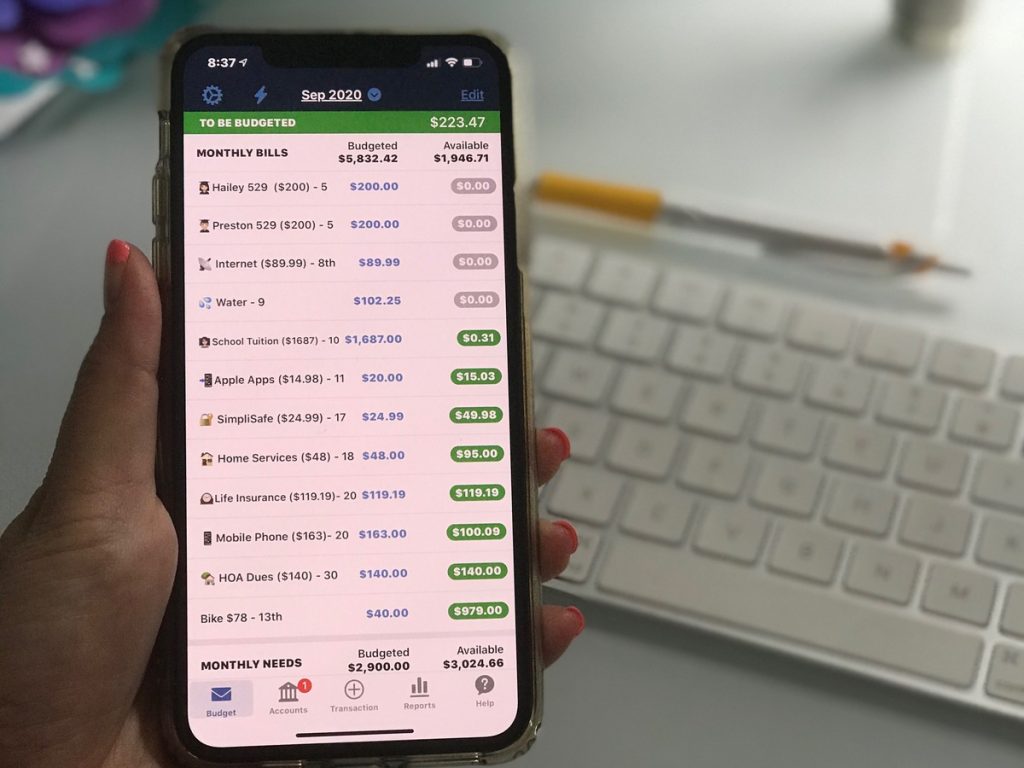
My family uses a quick and simple app called, YNAB. YNAB stands for You Need A Budget and it’s personal budgeting software available for Windows, Mac, and iOS. What I love about YNAB is that it’s super simple for me to divide and budget our funds into different categories. Then my husband and I can see what we have left to spend by simply looking at the app on our phone.
In the app, we set categories for all of our monthly expenses. When you add your budgeted amount to each category, it is automatically deducted from our monthly total. This might seem like a lot of work, but it’s really so quick and easy. Each month, it only takes me a matter of seconds to update our budgeted amount for each category, as opposed to all of the time it would take with cash envelopes.
Best yet, it updates instantly on all connected devices so my husband and I can both see, at all times, exactly how much money we have left in each category.
Hopefully, now you have a better understanding of a way to budget that is different from using cash envelopes and you can see if, maybe, this is a system that you would prefer. Let me know, which system has worked for you in the past or which system you think would work best for you and your family.
Do you like the idea of having access to your budget on an app on your phone at all times? I’d love to offer you a done-for-you/done-with-you family budget program! One where I will hand deliver a fully set up and organized YNAB budget plan based on your flow. I’ll work side-by-side with you to develop a routine and process to keep you on top of your family finances once and for all. Schedule a free 15 min call with me! Find out if we’d be a good fit and how I can help make it happen for you!
Did you ever start budgeting, just to end up too overwhelmed and then quit? Don’t feel bad if this is you, it’s so common! But that doesn’t have to be your story.
When my husband and I were first married, we found ourselves quickly buried in debt. Budgeting helped us to get out of over 120K in debt. But it took a lot of trial and error. I’m hoping that some of you will be able to learn from the missteps we made at the beginning.
If you are thinking about getting started with budgeting or if you’ve started before and quit, I want you to be successful from the start this time! Check out the top reasons people quit budgeting just after they start. You’ll be able to see the challenges and face them head on.
Here are the top 3 reasons people start budgeting but then end up quitting:
You just don’t know where to start.
You’ve heard all of these ways that other people are successfully budgeting, like cash envelopes, zero based budgeting, apps, and spreadsheets. You’re hearing it all but it’s overwhelming and it’s making you freak out. You just can’t figure out where to start.
There’s a lot of information out there to sift through and it absolutely is overwhelming. It’s hard to know what is the right system for you and your family. Because of the information overload, many people try and quit, or worse yet, they don’t even start.
You don’t have a solid foundation set up.
Many people who have the best intentions and really want to have a solid successful budget just don’t have the foundation in place to get started and stick to it. Before you even start budgeting, you need to get into the right mindset. Ask yourself why you want to budget. To be successful, you really have to know that piece. If you don’t have a clearly defined “why” your budget will continue to be low priority.
You start with a tool, process, or system that doesn’t work for you.
So many families start budgeting but they get started using the wrong tool, process, or system for their family or household. Obviously there are tons of different ways you can budget successfully but not every way is going to work for every family.
Before starting, it’s important to really consider the different options and what will work best for how your family operates. Make the best choice for your family, but also remain flexible and open minded. That way, if the system you chose to start with doesn’t work out for you, you can seamlessly move to a better fitting system.
What’s worked for my family:
The system that my husband and I have used to manage our household finances since 2013, when we got ourselves out of debt (and kept ourselves out of debt for all these years), is a system called YNAB. YNAB stands for You Need A Budget and it’s personal budgeting software available for Windows, Mac, and iOS.
YNAB is a system but it has helped us to create a routine and process for us and our household that works really very well. I would LOVE to show you how to use it as well.
If you are overwhelmed and you’re looking for a quick and easy way to get your household finances on track with a plan, we should chat.
Do you like the idea of a done for you/done with you family budget program? One where I will hand deliver a fully set up and organized YNAB budget plan based on your flow. I’ll work side-by-side with you to develop a routine and process to keep you on top of your family finances once and for all. Schedule a free 15 min call with me! Find out if we’d be a good fit and how I can help make it happen for you!
I’ve always known that we all possess certain behaviors around money. But, I never knew someone had actually coined these into personality types until I started reading Money Harmony by Olivia Mellan and Sherry Christie.
I’m always looking to learn new things to better myself and so that I can share them with others. According to the ladies who wrote Money Harmony, there are 9 money personality types. Now, we can all possess a combination of these money personality types. It’s not that one is good and one is bad, what we want is balance. Everything in moderation is the goal!
Here are 5 of those personality types and how you can use them to grow a healthy relationship with money for yourself and your family:
The Spender
Everyone can usually relate to this from time-to-time, especially if you’re someone with a bit of debt. Spenders are also often impulse buyers. You might have a tendency to spend a little too much and then feel guilty about it. It’s a cycle of spending followed by guilt. It can also cause some tension and friction in the family.
If you’re a spender, you can find a friend or accountability partner to help you out with this. Put them on speed dial and give them a call next time you’re ready to make an impulse buy. Take a step back and have your friend talk you through it.
You can also have a portion of your paycheck automatically transferred to your savings account. Now, since it’s deposited automatically, it’s done and you don’t even have to think about it!
The Hoarder
This person likes to save and doesn’t like to spend. You definitely don’t like to spend on yourself and you especially aren’t buying frivolous stuff! You’d prefer to save for a rainy day. We all want to save, but you need to be aware of if it is causing friction between you and your family or friends. If that’s the case, you’ll want to take a look at your habits.
Consider once a week spending $20 on a treat or a snack you can enjoy right then and there. Or, once a month, spend $25-$50 on a gift for someone you care for. See how that makes you feel and make note of what it brings up for you.
Giving to others can feel nice and balance out your tendency to save too much all the time. It’s great to save, but it’s also okay to splurge from time-to-time. Don’t feel guilty about that!
The Money Avoider
If you are so overwhelmed with your finances that you don’t have any idea about your money situation, this might be you! You don’t know what’s coming in or what you owe, this can get messy really quickly.
Reach out to a family member or friend who is good with money. Maybe even a professional who can help you get organized. It’s okay to start slow to get a handle on your finances. Maybe just choose 3 bills to start with. List out how much you owe and the due date and start to track them on the calendar on your phone. Each month, add on another bill and eventually you will be on top of everything you owe!
The Money Monk
This person thinks that money is evil or that you are not worthy of having money. What these people usually end up doing is self sabotaging. So, subconsciously you self sabotage to the point where your life is suffering.
It’s nice to be generous and to give back, but if it’s to the extreme that it’s harming you, that’s not good.
If you’re a money monk, try to think of people that are wealthy and doing really good things in the world. Ask yourself what qualities you admire or respect in those people. Then ask yourself what you have in common with those people. Chances are, you’ll find that they are generous and so are you. It will help you see that being wealthy isn’t bad. The more wealth you have the more you can do for others. It’s all about a simple mindset shift.
The Amasser
This is your workaholic – they eat, breath, and live for work! They feel they can never have enough money even if they live a comfortable life. They’re never satisfied with what they have. When they go on vacation with their family, they are always working. This type of behavior will cause friction within the family.
If this is you, you can make sure that all of your work is taken care of before going on a trip. If that sounds like too much, start out with just one day where you put all your focus on your family.
I’m guilty of this one myself. I get so engrossed in my work that I tune everyone and everything else out. Then, I feel bad about it. You can ask your kids and family how they perceive your relationship with work. The last thing you want is for your kids to only see you working. Then, they may grow up thinking all there is to life is work.
Do you see yourself in any of these money personality types? Are you one or a combination of a few? How about your spouse? If you and your spouse have different money personalities, that can be good! You can balance each other out.
Looking for help setting a family budget that works for all of the different personalities in your house? Book a FREE 15 min call with me to find out how I can help you with your budget plan. To schedule your call, click here!
Struggle with staying on top of your bills and budgeting?
Do you stress out and dread when the 1st of the month rolls around?
Tired of living paycheck to paycheck?
Have constant arguments with your spouse around the family finances?
Have no clue on how to even get in control of your financial life?
Download this FREE Monthly Budgeting Action Plan, which includes Worksheets with step by step instructions on guiding you exactly on what you need to do to set up your own family budgeting plan that works for you and your family.
Struggle with staying on top of your bills and budgeting?
Do you stress out and dread when the 1st of the month rolls around?
Tired of living paycheck to paycheck?
Have constant arguments with your spouse around the family finances?
Have no clue on how to even get in control of your financial life?
Download this FREE Monthly Budgeting Action Plan, which includes Worksheets with step by step instructions on guiding you exactly on what you need to do to set up your own family budgeting plan that works for you and your family.
Do you struggle with getting your kids to clean up their room?
Are you ready for your kids to be more responsible?
Would you like your kids to be able to manage their time better?
Ready for a simple way to teach your kids good money management habits?
Download this FREE Family Chore and Money System Action Guide. It includes worksheets with step by step instructions on guiding you exactly what you need to do to set up your own chore, schedule and money management plans.
 When you think of the word BUDGETING, what’s the first thing that comes to your mind?
 Being prepared in our finances can empower us because it impacts all of the areas of our life. Knowing this simple fact led me to put together a five phase journey based on my own experience with finances and the experiences of those I’ve helped along the way. My hope is that this framework will show you the path to financial freedom.

 Most people grow up not learning money lessons from their parents. They have to go through life and learn it the hard way, like I did. I learned from my parents to just – work, work, work, save and not spend. That can be a money lesson but I’m here to encourage you to teach your kids to manage their money more effectively.

 Do you use cash envelopes? Or do you know someone who does? Or maybe, like me, you’ve tried it and hated it!
 Did you ever start budgeting, just to end up too overwhelmed and then quit? Don’t feel bad if this is you, it’s so common! But that doesn’t have to be your story.

 I’ve always known that we all possess certain behaviors around money. But, I never knew someone had actually coined these into personality types until I started reading